
The conclusion first
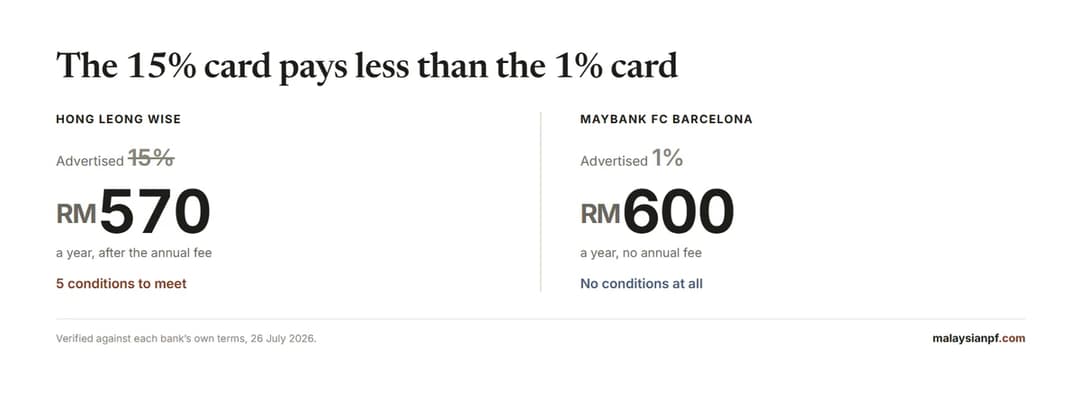
The Hong Leong Wise card advertises 15% cashback. After its caps, its minimum spend and its weekend-only rules, it nets you about RM570 a year.
The Maybank FC Barcelona card pays a flat 1% on everything, with no minimum, no categories and no annual fee. It nets you about RM600 a year.
The 1% card pays more money than the 15% card, and you never have to think about it once.
That is the whole post. Everything below is the working.
What changed since I last updated this
I wrote the original version of this post in 2024. Almost every number in it is now wrong, because the banks spent 2025 and 2026 quietly cutting.
- GXBank killed the 1% unlimited debit cashback that used to be my benchmark. It dropped to 0.1%, and today there is no live GXBank term sheet granting any domestic rate at all. Only an overseas 1% campaign that expires 6 November 2026.
- UOB ONE Classic went from RM500 minimum spend to RM800 in June 2025, then closed to new applicants entirely. New customers get pushed to the ONE Platinum at RM1,500 minimum.
- Alliance Bank removed every automatic annual fee waiver on 1 August 2025 and replaced them with relationship-based waivers.
- AmBank Cash Rebate Visa Platinum, historically a petrol card, now excludes petrol completely as of 30 September 2025.
- AEON discontinued the BiG cards on 5 January 2026, cutting the 5% Sunday petrol rebate down to 2%.
- HSBC Live+ lost its 3% booster in September 2025. The 8% that every comparison site still quotes has not existed for ten months.
- OCBC converted the 365 Mastercard and the Titanium to points, and CIMB's e Credit Card still carries the page title "Cashback Credit Card" while paying only Bonus Points.
If you are reading a cashback roundup that still lists any of the above, close it.
How I score a cashback card
Two numbers decide everything, and most comparison sites publish neither.
Real return. Not the advertised rate. The rate you actually get after the monthly cap bites. A card paying 15% capped at RM15 a month is a card paying RM15 a month.
Net annual value. Twelve months of maximum cashback, minus the annual fee you will actually pay after any waiver. A card advertising 8% that caps at RM15 a month is worth RM180 a year, and no percentage on the poster tells you that. Nobody puts the ringgit figure in a table, so I did.
Then I score how annoying it is to use, one point each for:
- a minimum monthly spend you must hit
- three or more separate bonus categories to track
- timing rules, like weekend-only
- caps that are per-category instead of pooled
- registration, app activation, or a merchant allowlist
One point is a card you tap. Five points is a part-time job.
I care about this because I have said it before and I still mean it. Credit cards are supposed to simplify your financial life, not add stress to it. That is why I have always leaned toward air miles cards, and why my own everyday card is the Alliance Bank Visa Virtual.
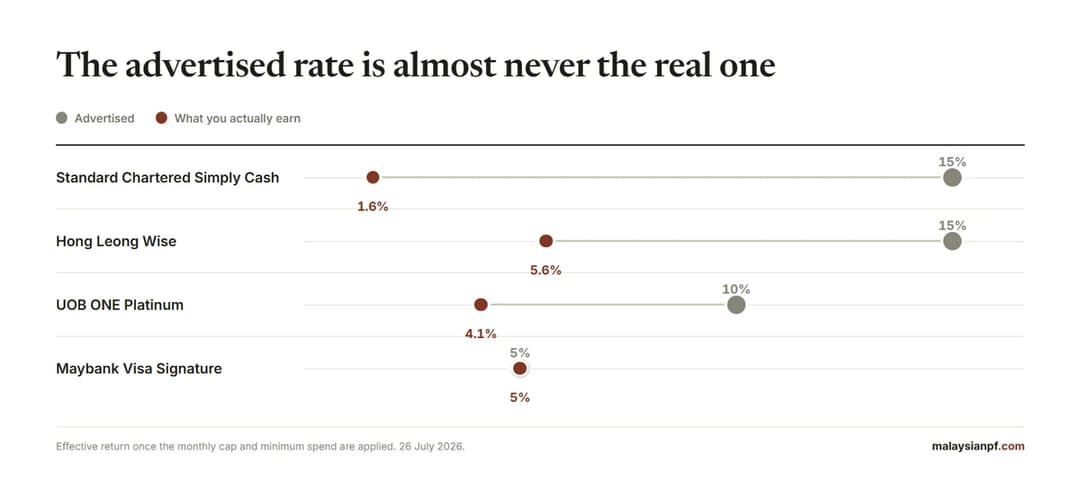
The advertised rate is almost never the real one
This has not changed since 2024. If anything it got worse.
Standard Chartered Simply Cash
Advertised: up to 15% cashback.
The real structure: below RM2,500 a month you earn 0.5%, capped at RM10. Hit RM2,500 and the 15% unlocks on petrol, groceries and dining at selected merchants, capped at RM40 total.
RM40 / RM2,500 = 1.6%
You need an income of RM96,000 a year to qualify for a RM40 monthly cap. The annual fee is RM250 and only the first year is waived.
Hong Leong Wise
Advertised: 15% cashback.
The real structure: RM1,000 minimum spend, dining at 15%, groceries and petrol at 10%, and the caps are RM20 for dining plus RM15 each for the others. Weekends only. Self-service pumps only. Online merchants must be on their allowlist. Weekday spending in those same categories drops to 0.5%.
Maximum RM65 a month if you split your spending perfectly across four categories on Saturdays and Sundays. The annual fee is RM98 and there is no waiver, ever. It is the only card I found with a hard no-waiver clause written into the terms.
UOB ONE
Advertised: up to 10% cashback.
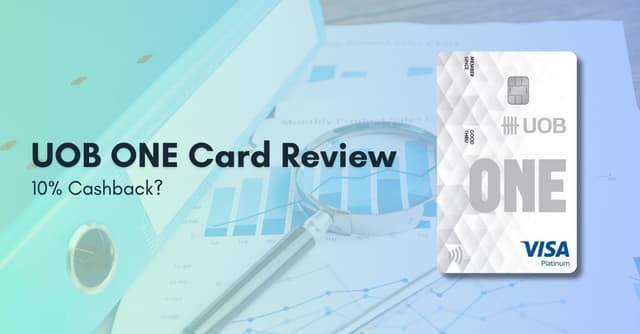
I already wrote a full review of this card, so briefly: the Platinum needs RM1,500 a month, pays 10% on petrol, selected groceries, dining and Grab, and caps each of those four at RM15. Everything else earns 0.2%.
Best case is about RM62 on RM1,500, or 4.12%.
That is a decent card. It is not a 10% card.
The trick buried in the terms
This one is worth reading twice, because it is easy to miss and it changes the maths.
Spending that earns you zero cashback still counts toward the minimum spend you need to unlock cashback.
Hong Leong states it outright in clause 3(a) of the Wise terms:
For all government, JomPAY and/or FPX transactions, the amount spent from these transactions will contribute and form part of the minimum spend of Ringgit Malaysia One Thousand (RM1,000) for each calendar month. However, these transactions will not be entitled to any Cashback.
Their own FAQ then asks how much cashback you earned on the JomPAY transaction. The answer they print is RM0.
HSBC does the same thing by omission. Their exclusion list strips cashback from petrol, utilities, insurance, education and e-wallet top-ups, but the separate list of what counts toward your monthly qualifying spend does not exclude any of them. Their own worked example shows a RM600 e-wallet top-up sitting inside the RM5,000 qualifying spend with both cashback columns blank.
RHB Shell is worse. Non-Shell petrol counts toward your tier and pays nothing, which is worse than ordinary spending, because ordinary spending at least earns 0.2%.
UOB is the honest one here. Government transactions and JomPay are excluded from the rebate and from the minimum spend calculation. They do not earn and they do not help you qualify. That is the correct way to write it.
Best simple cashback cards
These are the ones you can just use. One or two points of annoyance, no more.
| Card | Real return | Net per year | The catch |
|---|---|---|---|
| Maybank Visa Signature | 5% petrol and groceries | RM1,056 | RM30,000 a year to waive the fee |
| Alliance Bank Visa Platinum Virtual | 1.33% equivalent | RM960 | Paid as points, not cash |
| Maybank Islamic Ikhwan Amex Platinum-i | 8% online | RM700 | Recurring and subscription charges excluded |
| Affin DUO+ Visa | 3% on all contactless | RM600 | Each transaction must be RM250 or under |
| Maybank FC Barcelona | 1% on everything | RM600 | Telco and broadband bills excluded |
| AmBank CARz-i | 2% petrol, any brand | RM240 | Cap is only RM20 a month |
None of these has a minimum monthly spend. That is the point of the group.
Maybank Visa Signature has the biggest cashback ceiling in the country at RM88 a month, and it is a single pooled cap rather than four separate ones, which is why it fills up without you managing it. The catch is the grocery MCC allowlist. Only 5411, 5422 and 5451 qualify, so a hypermarket coded as a department store earns you nothing.
One oddity worth flagging, because it shows how carelessly these documents are written. The English terms exclude "Government Bodies, utilities and e-wallets reloads". The Bahasa Malaysia version of the same PDF excludes "Petrol, Syarikat Penerbangan, Badan Kerajaan, utiliti, dan tambah nilai e-dompet", which adds petrol and airlines to the list.
On a card whose own title is "Cash Back for Petrol & Grocery". Whose clause 1 grants 5% on petrol in both languages. Whose eligible MCC table lists 5541 and 5542 in both languages.
The same document also carries a leftover sentence saying a transaction is not eligible if it does not fall on a weekend, on a card that has no weekend rule at all. Both look like copy-paste residue from Maybank's weekend Amex card, which genuinely is weekend-only and genuinely does exclude petrol.
I am reading the English version as the operative one, because everything else in the document agrees with it. But if you are relying on the petrol rebate, take a screenshot of your statement for the first couple of months.
Affin DUO+ is the closest thing to a flat-rate card in the market. 3% on any contactless transaction, no categories at all. Each transaction has to be RM250 or under and there is an anti-splitting clause, so it suits groceries and petrol rather than big purchases.
Maybank FC Barcelona is the purest version of the idea. 1% on everything, free for life, nothing to track. It is the card in the comparison at the top of this post.
Best if you are willing to work for it
| Card | Real return | Net per year | Min spend |
|---|---|---|---|
| AEON Member Plus Gold | 8% at AEON on the 20th and 28th | RM1,500 | None |
| CIMB PETRONAS Visa Infinite-i | 5% at the RM1,500 tier | RM1,440 | RM1,500 |
| RHB Visa Signature | 1.86% realistic | RM1,128 | RM3,500 |
| HSBC Amanah MPower Platinum-i | 2.43% at RM2,000 | RM584 | RM2,000 |
| Hong Leong Wise | 5.57% at RM1,000 | RM570 | RM1,000 |
| UOB ONE Platinum | 4.12% at RM1,500 | RM547 | RM1,500 |
The AEON cards are the only ones where the effort clearly pays. RM1,500 a year is real money. But you have to do your entire month of shopping at AEON on two specific dates.
Everything else in this table is beaten by a card in the previous table.
Forget the annual fee, look at the cap
I went into this expecting to find cards where the annual fee eats the cashback. Mostly, I did not. The fees are theatre.
Public Bank Visa Signature charges RM388. Bank Islam Visa Infinite-i charges RM777. Public Islamic Visa Platinum-i charges RM333. All three waive it on 12 transactions a year. One swipe a month. If you are using the card at all, you are not paying that fee.
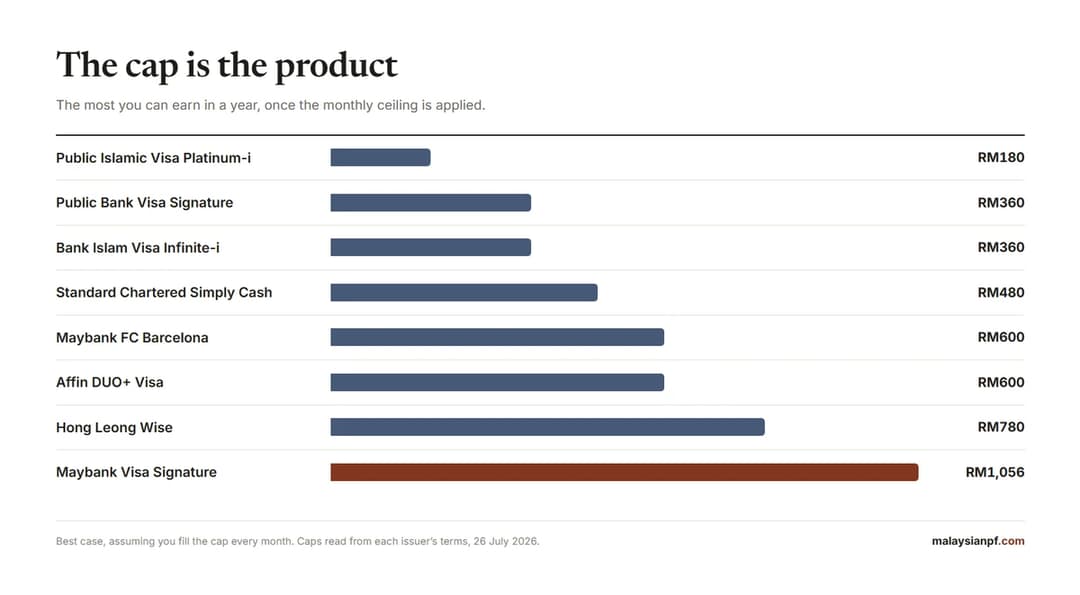
So the headline fee is mostly noise. What actually decides your money is the number nobody advertises: the monthly cap.
| Card | Monthly cap | Most you can earn in a year |
|---|---|---|
| Public Islamic Visa Platinum-i | RM15 | RM180 |
| Public Bank Visa Signature | RM30 | RM360 |
| Bank Islam Visa Infinite-i | RM30 | RM360 |
| Standard Chartered Simply Cash | RM40 | RM480 |
| Maybank FC Barcelona | RM50 | RM600 |
| Affin DUO+ Visa | RM50 | RM600 |
| Hong Leong Wise | RM65 | RM780 |
| Maybank Visa Signature | RM88 | RM1,056 |
A card called Visa Infinite, with a RM777 fee on the sticker, limits you to RM30 a month. That is the whole product. The rate on the poster, the tier of the card and the size of the fee tell you nothing about what lands in your account.
Two cards do charge a fee you cannot dodge. Hong Leong Wise is RM98 with no waiver written into the terms at all, which is unusual enough that I double checked it. Standard Chartered Simply Cash waives only the first year, then charges RM250 against a RM480 ceiling.
Work out your own ceiling before you apply. I built a credit card finder that lists the annual fee on every card, and there is a balance transfer calculator if you are carrying a balance, which matters far more than any cashback rate.
What about debit cards now that GXBank is gone
The whole category collapsed. Every one of these was checked in July 2026.
| Card | Domestic | Note |
|---|---|---|
| GXBank GX Card | 0% | No live term sheet grants a domestic rate |
| Ryt Bank | 0% | 1.2% overseas against a 2% FX fee is net negative |
| AEON Bank Debit Card-i | AEON stores only | The 4% grocery claim expired 28 February 2026 |
| RHB Debit | 0% | RM12 annual fee, so you are down RM12 |
| Public Bank PB-Petron Debit | 0.5% at Petron | Under RM20 a year in practice |
| Wise, KAF, BigPay | 0% | No cashback programme exists |
Do not pick a debit card for rewards in 2026. The one exception worth watching is Boost Bank at 2%, but its published campaign period ended on 30 June 2026 and I could not find an extension notice, so check it in the app before you count on it.
So what should you actually get
If you drive and buy groceries and can put RM30,000 a year through one card, the Maybank Visa Signature pays more than anything else without making you work for it.
If you want to stop thinking entirely, Maybank FC Barcelona or Affin DUO+. One percent on everything, or three percent on every tap. No minimum, no categories, no calendar.
If you are chasing the 15% headline, read the caps first. In almost every case the headline is worth about RM25 a year more than tapping a card and thinking about nothing, and sometimes it is worth less.
The rate on the poster is marketing. The cap is the product.
What are you using right now, and have you actually worked out what it pays you after the cap? I would genuinely like to know if anyone is beating RM1,056 a year without doing gymnastics for it.