
Introduction
A reader asked me last month which one he should open, Moomoo or Interactive Brokers. He had read that Moomoo is licensed here and IBKR is not, and that worried him.
It is a fair question, and the fee tables everyone publishes do not really answer it. So here is my conclusion first: for buying US stocks and holding them, I use Interactive Brokers, and the reason has almost nothing to do with commission. It is the currency conversion, and the fact that Moomoo cannot buy the funds I actually want.
But Moomoo wins on two things that matter to some people, and one of them is the thing my reader was worried about. Let me show you the numbers.
Is IBKR safe for Malaysians?
This is the real question behind most Moomoo vs IBKR searches, so let me deal with it before the fees.
Moomoo Malaysia is licensed here and IBKR is not. Moomoo Securities Malaysia holds a Capital Markets Services Licence from the Securities Commission Malaysia, licence number eCMSL/A0397/2024, and it is a Bursa Malaysia participant. IBKR holds no Malaysian licence. Its own regulatory disclosures list every entity it operates through, and there is no Malaysian one on that list.
So if your test is "who can I complain to in Malaysia", Moomoo genuinely wins. That is not nothing, and anyone who tells you otherwise is selling you something.
Here is the other side though. As a Malaysian you are onboarded to Interactive Brokers LLC in the United States, and client securities accounts there are covered by SIPC up to US$500,000, with a US$250,000 cash sublimit, plus an excess policy through Lloyd's of London on top. There is no residency condition attached to that coverage.
Funny detail: the Singapore version of that page is actually weaker, because Singaporeans go through IB Singapore and SIPC only applies to the extent their assets sit at the US entity. On paper a Malaysian is better protected than a Singaporean here.
One thing to watch, since it trips people up. The SC's investor alert list does carry entries for clone websites using names like Interactive Brokers, set up to look like the real thing. The real IBKR is not on that list. If you go looking, make sure you are on interactivebrokers.com and not something that merely resembles it.
Is Moomoo approved by Bank Negara?
No, and it does not need to be. Brokers are licensed by the Securities Commission, not BNM. BNM regulates banks, insurers and payment businesses. If someone tells you a broker is "BNM approved", they have got the wrong regulator.
What You Can Actually Buy
Now the part almost nobody writes about, and in my view it matters more than every fee in this article.
A Moomoo Malaysia account can trade five markets: the US, Bursa Malaysia, Singapore, Hong Kong, and China A-shares through Stock Connect. That is it. There is no London Stock Exchange, and no European exchange of any kind.
Why that matters: as a Malaysian buying US index funds, I do not buy VOO. I buy Irish-domiciled ETFs like SPYL, because a US-domiciled fund withholds 30% of your dividends while an Irish-domiciled one withholds 15%. I wrote about the reasoning in my Irish-domiciled ETF post. Those funds trade in London.
Moomoo cannot buy them. Not CSPX, not VWRA, not VUAA, not SPYL. There is no workaround either. A US-listed version does not exist, because UCITS funds are not sold to US investors in the first place. And before you ask, Moomoo Singapore cannot do it either.
To be fair about how I know this: Moomoo does not publish a page saying "we do not offer London." Brokers never publish what they cannot do. But its account documentation lists those five markets, its pricing page has five fee cards, and there is no London card. A broker that offered the market would have a price list for it.
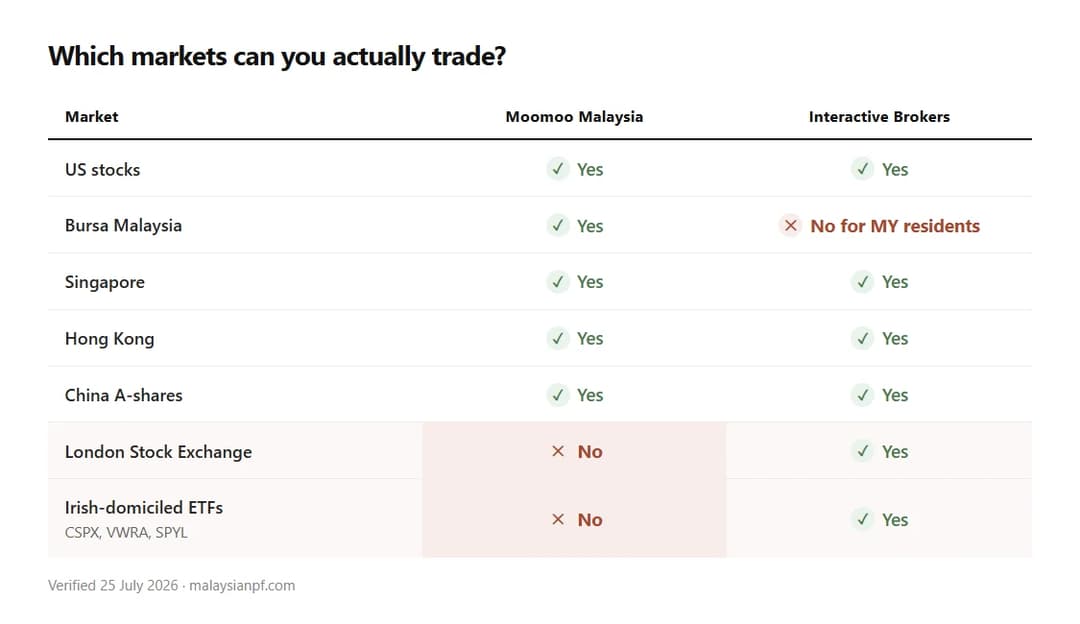
The last two rows are the ones that decide it. On the Bursa row, see the note further down: IBKR advertises Malaysian shares but does not offer them to Malaysian residents.
So if you plan to hold index funds for twenty years, this is the whole decision, and the fee tables below are a footnote.
But how much is that 15% actually worth?
Let me argue against myself for a second, because the Reddit consensus overstates this.
The S&P 500 yields somewhere around 1.3% right now. On a RM100,000 portfolio that is RM1,300 in dividends a year, and the difference between 30% and 15% withholding is 15% of that:
RM1,300 x 15% = RM195 a year
That is real, but it is not life-changing, and it is smaller than one bad currency conversion. At RM1,000,000 the same sum is RM1,950 a year, and now it compounds into something that matters over decades.
Honest verdict: below roughly RM50,000 invested, the withholding tax argument is close to noise, and convenience should probably win. Above a few hundred thousand it becomes the main event. There is also US estate tax to think about once you hold more than US$60,000 of US-domiciled assets, which is another argument for the Irish funds, and a topic for another post.
Moomoo vs IBKR fees for US stocks
Both brokers publish their rates, so this part is simple. Everything below is the standard rate as of 25 July 2026, checked on their own fee pages.
| Fee | Moomoo Malaysia | Interactive Brokers (Pro, Tiered) |
|---|---|---|
| Commission | 0.03% of trade value | US$0.0035 per share, min US$0.35 per order |
| Platform fee | US$0.99 flat per order | None |
| Minimum commission | None, rounded up to US$0.01 | US$0.35 per order |
| Other charges | Settlement, SEC on sells, FINRA TAF on sells, CAT | Small regulatory and exchange pass-throughs |
| Annual or inactivity fee | None | None |
| Malaysian stamp duty | RM1 per RM1,000, capped RM1,000 | Same government levy applies |
IBKR does not charge a platform fee at all. Their commission page puts it plainly: no added spreads, ticket charges, platform fees, or account minimums. I mention it because a few comparison articles claim otherwise.
Worked example, a US$1,000 buy of five shares at US$200:
Moomoo: 0.03% commission = US$0.30, plus US$0.99 platform fee = about US$1.29 IBKR: US$0.35 minimum commission plus a few cents of pass-through fees = about US$0.37
On a US$10,000 order of 50 shares, Moomoo is roughly US$3.99 and IBKR is about US$0.51.
So IBKR is three to eight times cheaper on commission. But hold on, because those are single-dollar numbers and I am about to show you a much bigger one.
Currency Conversion Costs
Here is the cost nobody puts in their comparison table, and it dwarfs the commission.
I converted RM200,000 through Moomoo in January this year, and I recorded the rates. I did the same again two days later. These are my own numbers, not Moomoo's marketing.
| Date | Moomoo roundtrip loss | Sell spread vs Wise mid-market |
|---|---|---|
| 31 January 2026 | 1.28% | 0.73% |
| 2 February 2026 | 1.41% | 0.79% |
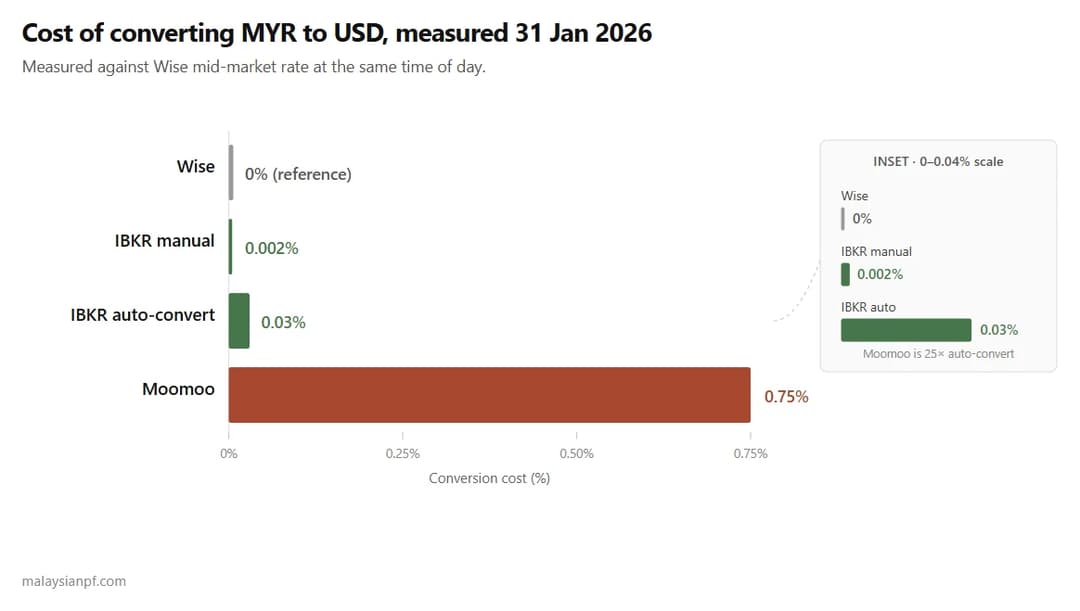
Moomoo's conversion cost about 25 times what IBKR's auto-conversion does. (Source: my own conversions, measured against the Wise mid-market rate at the same time of day.)
Moomoo says its exchange rate comes from the upstream bank and that the service is "free". There is no published spread, so the cost is real but invisible, buried in the rate you get. Their own pricing FAQ lists foreign exchange as one of the ways the company makes money, which tells you what you need to know.
IBKR publishes its FX cost as a number:
| Route | Cost |
|---|---|
| IBKR manual conversion on IDEALPRO | 0.002% of value, minimum US$2 per conversion |
| IBKR auto-conversion when you buy | 0.03% built into the rate |
| Moomoo | No published figure. I measured 0.73% to 0.79% against Wise mid |
Now put it next to the commission. On a US$1,000 trade:
IBKR commission: about US$0.37. IBKR conversion: US$2 manual, or US$0.30 on auto. So the currency conversion costs more than the trade itself.
And on Moomoo, converting RM4,000 at a 0.75% spread costs you about RM30, which is roughly ten times the commission you were comparing so carefully.
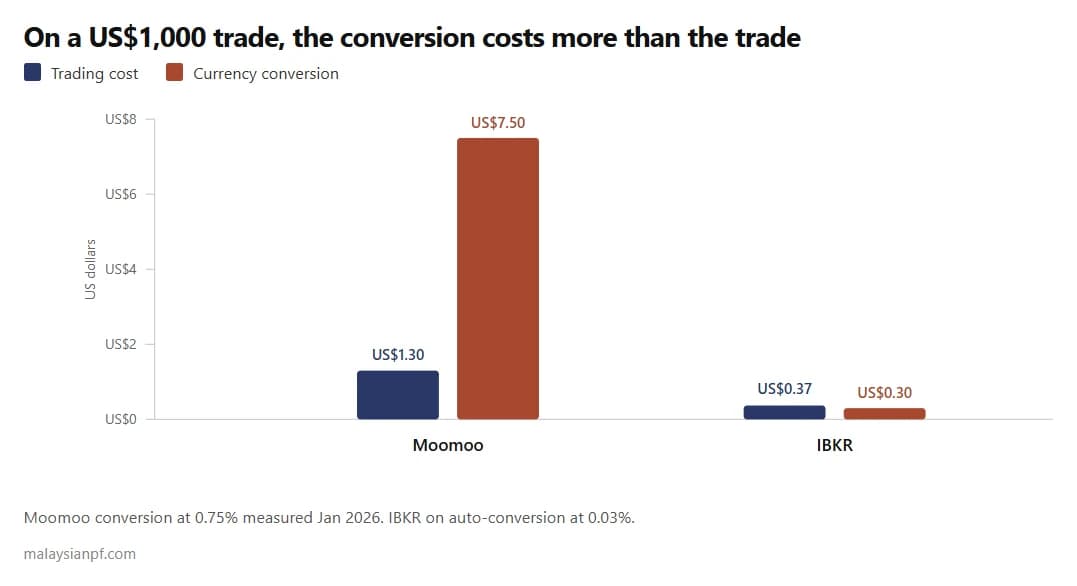
To be fair to the chart above, it assumes you convert the full US$1,000 for that one trade. If you convert in bulk and then buy over several months, you pay that conversion cost once and spread it across every purchase, which is exactly why funding size matters.
That is the point of this whole article. Everyone argues about commission. The conversion is the bigger number, and it is the one Moomoo does not publish.
One useful IBKR detail: the manual conversion has a US$2 minimum while auto-conversion is a flat 0.03%, so they cross over at about US$6,700. Below that, let it auto-convert. Above it, convert manually.
Cheaper still is funding in EUR through Wise, which I walk through in the cheapest way to fund IBKR. Wise charges roughly 0.52% MYR to EUR, sends to IBKR free, and then IBKR auto-converts to USD at 0.03% when you buy.
Moomoo vs IBKR for Bursa Malaysia stocks
For local stocks Moomoo is straightforwardly the better choice, and this is where its licence earns its keep.
| Broker | Commission | Platform fee | Total on a RM10,000 trade |
|---|---|---|---|
| Moomoo Malaysia | 0.03% | RM3 per order | RM3 + RM3 = RM6 |
| Affin eInvest | flat | none | RM5 |
| Rakuten Trade | about 0.05% tiered | none | around RM7 |
| Maybank or Mplus | 0.08% to 0.10% | none | RM8 to RM12 |
Note the RM3 is a separate platform fee, not a minimum. It is added at every order size, so it does not disappear on bigger trades. A lot of write-ups get this wrong, and I had it wrong myself in an earlier version of my Moomoo review.
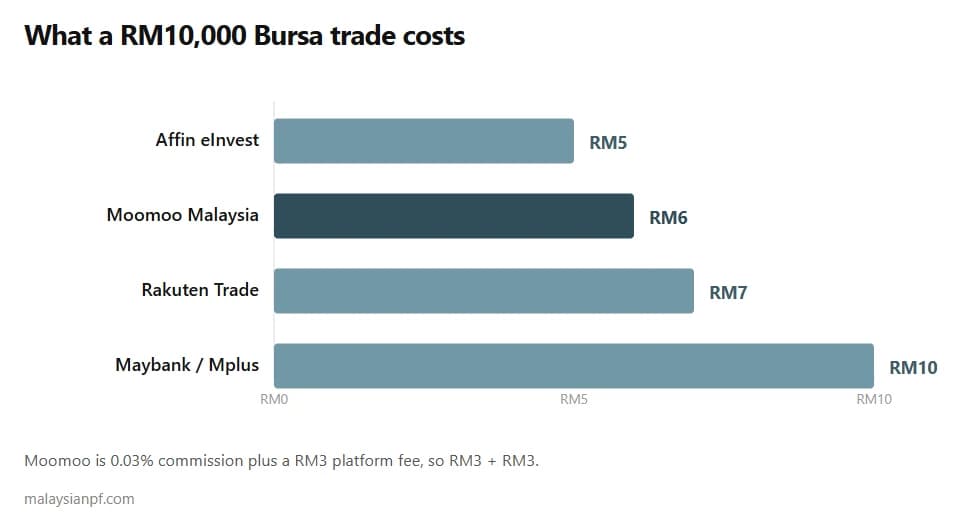
On top of commission you pay a clearing fee of 0.03% capped at RM1,000, and stamp duty of RM1 per RM1,000 capped at RM1,000.
About that 8% SST. You will read that Malaysia's 8% service tax applies to brokerage since 1 October 2025. For ordinary shares that is not true. Brokerage on shares listed on Bursa is exempt, under Item 12 of Service Tax Policy 1/2025 and confirmed on Bursa's own SST page. The 8% does apply to ETFs, REITs, warrants, rights and a few other instruments. It never applies to stamp duty, which is a tax rather than a service.
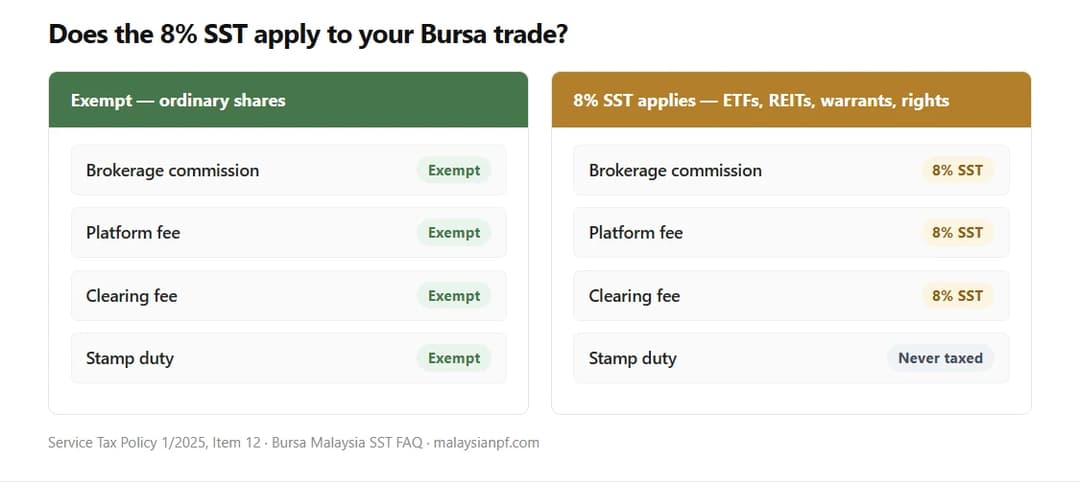
A small irony: Bursa-listed ETFs are exempt from stamp duty until the end of 2028, but they do attract the 8% on fees. Ordinary shares are the reverse.
Can you buy Bursa shares through IBKR?
No, not if you are a Malaysian resident. This one catches people out, so it is worth being precise.
IBKR's own Bursa page advertises MYR-denominated shares and ETFs on the Main Market and ACE Market, live since August 2024, and its fee schedule even lists Malaysian stock commission at 0.08% with a MYR12 minimum. That product is real. It is just not for you. It is for clients who are eligible to trade Bursa, and residents of Malaysia are not among them.
IBKR's own support channel has said so publicly: trading on Bursa Malaysia is not available to residents of Malaysia. Plenty of Malaysians have found this out the hard way, funding an account, seeing the local stocks listed, then having the request to enable trading fail before support confirms the restriction.
It is the same treatment IBKR applies to Singapore residents buying Singapore stocks, they just never put a Malaysian notice on the marketing page.
So use a local broker for local shares, which is what I would do anyway at RM6 a trade, and use IBKR for what it is genuinely good at: the US market, London-listed Irish ETFs, and the rest of the world. On Bursa futures I have no first-hand experience and would not assume the marketing page applies to a Malaysian-resident account either, so ask support first.
What it costs to leave
Worth knowing before you pick, because most people do not think about the exit.
Moving your shares out of Moomoo to another broker costs US$60 per stock per transfer for US holdings, and RM20 for Malaysian ones. Transfers in are free, which tells you which direction they would like you to go.
This matters because the most common advice you will read is to start with Moomoo and switch to IBKR once your portfolio grows. If you hold ten US stocks, that switch costs US$600. Selling and rebuying instead means crystallising gains and eating the spread twice. Not a reason to avoid Moomoo, but plan for it.
Where your shares actually sit
One structural difference that never shows up in fee tables.
Moomoo Malaysia routes international orders through Futu Securities in Hong Kong, and uses designated custodians for foreign securities. So your US shares are held under a Futu group entity in Hong Kong. With IBKR you face Interactive Brokers LLC in the US directly.
Neither is alarming. Both are normal industry structures. But it is worth knowing there is an extra entity in the chain on one side and not the other, especially if the reason you chose Moomoo was that it felt closer to home.
The promo, honestly
The genuine reason to open Moomoo right now is the sign-up campaign, and I say that as someone who does not use it as a main broker.
Moomoo runs a rolling new-customer promotion that resets every couple of months. The structure stays the same even though the numbers change: deposit and hold cash for 60 days across a ladder of tiers, and collect cash coupons plus a slice of a "hero" stock. As I write this the run goes to 23 September 2026, the tiers are RM1,000, RM3,000, RM10,000 and RM40,000, and the stock is Apple.
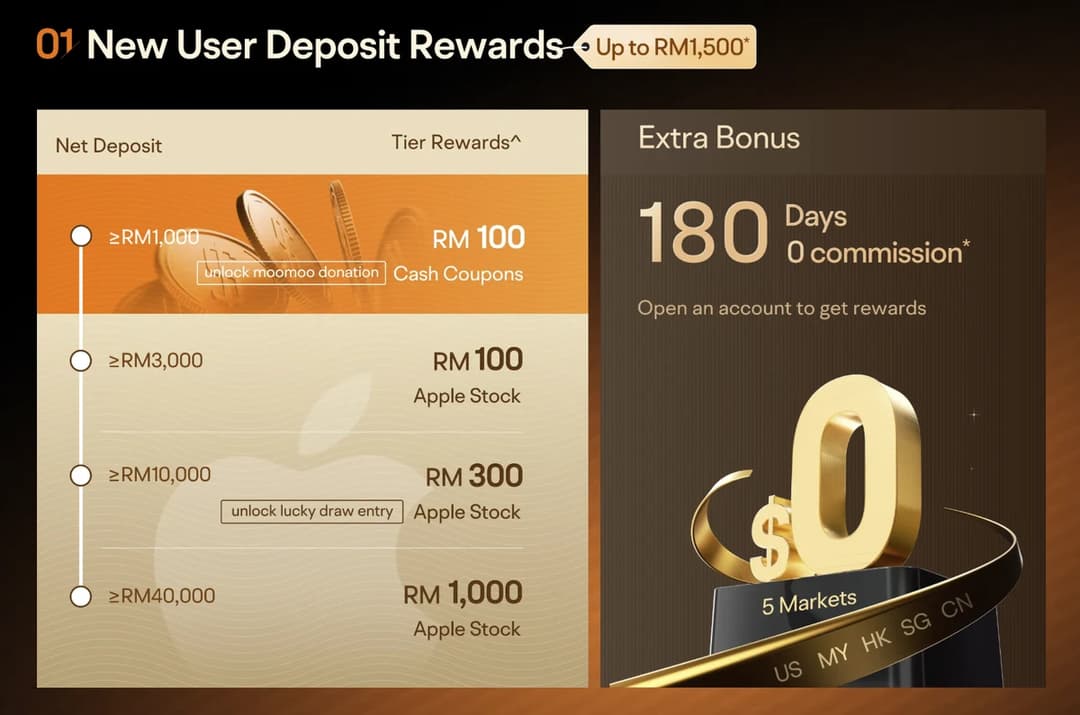
The tier ladder as it stood in July 2026. (Source: Moomoo Malaysia promo page, 25 July 2026.)
Do the math on why it is worth the paperwork. Roughly RM700 of rewards on a RM10,000 deposit held 60 days is 7% over the period, or about 42% annualised, for money you were going to invest anyway.
Two catches. The tiers and the stock change every cycle, so check the live promo page rather than trusting the numbers above. And the "180 days zero commission" for new users waives commission only. You still pay the RM3 platform fee, clearing, stamp duty and any SST due. Zero commission is not zero cost. Moomoo has also said the 180-day period will become 150 days at some point.
If you decide a campaign is worth it, you can sign up with my referral link, and I earn a reward if you fund an account. I also have an IBKR referral link in my IBKR guide. I would rather tell you that outright than pretend I am neutral.
So which one should you pick?
Open IBKR if you are buying US or global index funds and intend to hold them. The Irish-domiciled ETFs are only available there, the conversion cost is a fraction of Moomoo's, and the commission is lower too. This is what I do.
Open Moomoo if you mainly trade Bursa stocks, if you want the sign-up rewards, or if being able to deal with an SC-licensed company in Kuala Lumpur is worth more to you than a few hundred ringgit a year. Those are legitimate reasons and I am not going to talk you out of them.
Open both if you want the promo money and the proper long-term account, which is honestly what a lot of people end up doing. Just remember the transfer-out cost, and use each for what it is good at.
What I would not do is choose based on the commission table alone. On a RM4,000 purchase the commission gap is a couple of ringgit and the conversion gap is about thirty. The invisible cost is the one worth optimising.
Which way did you go, and did the conversion cost factor into it at all? I am curious whether anyone has tested Moomoo's rate against Wise recently, because mine was a January reading and rates move.