

Updated July 2026. Every rate below carries the date its source published it. Money market fund yields move constantly, so check the provider's own page before you shift money. This is personal research, not financial advice.
Quick Answer
Malaysian money market funds pay roughly 3.1% to 3.4% a year right now. The best retail fund pays 3.77% and the median pays about 3.16%, so chasing the top of the table is worth roughly RM61 a year on RM10,000.
None of them are PIDM protected.
That second sentence matters more than the first. A licensed digital bank will pay you 3.55% with PIDM protection on money you can commit for six months, which is more than any money market fund on this list. So the question is no longer "which app has the best rate". It is "how much am I parking, and for how long".
The Comparison
Every figure below is dated because these numbers move.
| Platform | Rate with no conditions | Best rate, with conditions | Underlying fund | Withdrawal | PIDM |
|---|---|---|---|---|---|
| KDI Save | 2.88% p.a. | 3.88% (needs RM5,000 in KDI Invest) | Not disclosed | 1-2 working days, no cut-off published | No |
| Versa Cash | 3.48% p.a. (June 2026) | Boosts are invite-only | AHAM Enhanced Deposit | T+1, cut-off 3:00 PM | No |
| Versa Cash-i | 3.09% p.a. (June 2026) | Boosts are invite-only | AHAM Aiiman Enhanced i-Profit | T+0, cut-off 10:00 AM | No |
| StashAway Simple | 3.4% projected | 3.55% for 6 months, new customers | Principal Islamic MMF 80% / AmIncome 20% | 3-4 business days | No |
| TNG GO+ | ~3.11% (fund 1Y, 30 Jun 2026) | None | Principal e-Cash | Instant, but to eWallet only | No |
| Moomoo Cash Plus | 3.29-3.34% (fund 1Y) | "6%" promo, 30 days, worth about RM23 | Maybank, UOB or Eastspring | To brokerage account, then 1-3 days to bank | No |
| FSMOne | Buy the fund directly | No promo rate | Your choice of 20+ funds | 2 business days, cut-off 3:00 PM | No |
| GXBank Bonus Pocket | 2.00% base | 3.55% on a 6-month pocket | It is a bank deposit | Locked for the tenure | Yes, to RM250,000 |
Sources: each provider's own page, retrieved 26 July 2026. Fund returns are from the fund manager's own fact sheets, not from the platform's display.
What You Are Actually Holding
Here is the thing almost nobody tells you. Open the fact sheets and these funds are, overwhelmingly, bank deposits.
- Principal e-Cash, the fund behind TNG GO+: 91.6% term deposits, 8.4% cash, as at 30 June 2026. No treasury bills, no commercial paper, no sukuk.
- Maybank Retail Money Market-I: "Cash 100.00%" as at 31 May 2026.
- Eastspring Islamic Income Class R: 100% cash and cash equivalents.
- AHAM Enhanced Deposit, behind Versa Cash: 88.2% deposits, 10.5% short-term bonds.
So you are lending money to banks, through a fund, and paying roughly 0.25% to 0.45% a year for the privilege. In exchange you get better rates than a savings account and no fixed deposit lock-in. That is a genuinely reasonable trade. It is just not the exotic thing the word "fund" suggests.
But the label is not a guarantee of what is inside. Some products sold as money market funds hold a lot of corporate debt:
| Fund | What it actually holds |
|---|---|
| RHB Money Market Fund | 91.42% unquoted corporate bonds, including 17.76% in a single issuer, DRB-HICOM |
| AmIncome | 66.21% corporate bonds, including perpetuals and a 2032 MTN |
That AmIncome number deserves a pause, because AmIncome is 20% of StashAway Simple, which StashAway classifies as "Ultra-low" risk and describes as holding "fixed deposits and short term bonds". AmIncome's own July 2026 fact sheet classifies it as Fixed Income, not money market.
A 17.76% position in one company inside a product people treat like a savings account is not a scandal. Nothing has gone wrong. But you should know it is there, and none of the apps will tell you.
The Advertised Rate Is Usually Not the Rate
This is the part that costs people real money, so let me be blunt about each one.
KDI Save. The 3.88% is labelled in Kenanga's own terms as a "Promotional Interest Rate" that they may "revise, vary or discontinue". To get it you must keep at least RM5,000 in KDI Invest, which is a market-risk portfolio, not cash. Park cash alone and you earn 2.88%. I went through the whole change, and what qualifying actually costs you, in my KDI Save review.
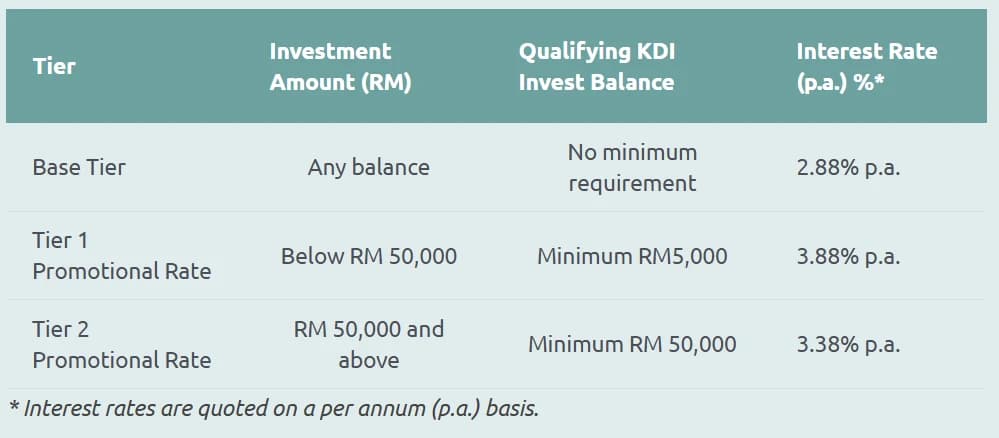
Note the third column. That is the whole story: every rate above the base requires you to hold a separate balance in KDI Invest. (Source: Kenanga Digital Investing, July 2026.)
The tiers are also marginal, which nobody explains. Your first RM50,000 earns Tier 1, and only the excess earns Tier 2. And Tier 2 needs RM50,000 in KDI Invest, not RM5,000. So if you hold RM5,000 in KDI Invest and RM80,000 in KDI Save, the last RM30,000 earns the base 2.88%, not 3.38%.
Versa. The advertised "up to 4.2%" is invite-only. The "10% p.a." is for new joiners and capped at the first RM500 of balance. Run that: RM500 at 10% for one month is about RM4. Versa is upfront that they "sponsor the difference" on these rates, which is more honest than most, but a sponsored rate is a marketing budget, not a yield.
StashAway. The headline says "projected 3.55% p.a." The asterisk resolves to this, on their own page:
"The projected rate is not guaranteed and is 3.4% p.a. as of 19 August 2025."
So 3.4% is the number, 0.15% is a six-month new-customer boost, and the underlying data is from August 2025. Their realised-returns table stops at 30 June 2025.
Moomoo. The "6% p.a." is not a yield at all. Moomoo tops up only the gap between 6% and whatever the fund itself earned, for 30 days, on up to RM30,000, for new money.
If all of that sounds hard to compare, it is, deliberately. So here is every live promotion priced the same way: what it actually adds if you park RM10,000 for three months.
| Promotion | Headline | What it actually adds | Expires |
|---|---|---|---|
| AmBank eFD | "up to 3.70%" | +RM42 over its own board rate | 31 Aug 2026 |
| Ryt Bank bonus | "up to 4%" | +RM36 | 30 Sep 2026 |
| KDI Save Tier 1 | "3.88%" | +RM25 over the 2.88% base | No expiry, revocable |
| FSMOne new user | "RM25" | +RM25, as non-cashable credits | 31 Jul 2026 |
| Moomoo Cash Plus | "6%" | +RM23, 30 days only | 31 Aug 2026 |
| Versa Fixed Rate Quest | "4.2%" | +RM18, and it is invite-only | 31 Aug 2026 |
| Versa Auto Save | "10%" | +RM12, capped at RM500 of balance | 31 Jul 2026 |
| Boost BoostUP | "4.0%" | +RM7.48, capped at RM3,000, needs RM500/month of spend | 17 Nov 2026 |
| StashAway boost | "+0.15%" | +RM3.74 | Not published |
Not one of them is worth more than about RM42. A "10%" headline pays twelve ringgit. Choosing the right platform for its underlying rate matters more than every promotion on that list combined, and it keeps paying after the promo dies.
Moomoo also displays a "7-day annualised return", which takes one week of performance and multiplies it out by 52 to give a yearly figure. That amplifies any one-week quirk fifty-two-fold, and it is most misleading exactly when rates are moving. It is a snapshot, not a forecast. There is no Malaysian regulatory definition of that metric, and Moomoo does not disclose how it calculates it.
Here is the general rule. A money market fund has no rate. It has a portfolio. A fixed deposit is a contract at a stated rate and the bank owes you that rate. A money market fund distributes whatever it earned, recalculated daily. Anything that looks like a promised rate is either a promotion or a projection.
Withdrawal Speed Is the Thing People Underrate
Everyone compares rates. Almost nobody compares how long it takes to get the money back, which is strange, because the entire point of parking cash is being able to reach it.
| Platform | Stated time | Cut-off | Lands in |
|---|---|---|---|
| TNG GO+ | Instant | None | Your eWallet only |
| Versa Cash-i | T+0 | 10:00 AM | Bank account |
| Versa Cash | T+1 | 3:00 PM | Bank account |
| KDI Save | 1-2 working days | Not published | Bank account |
| FSMOne | T+2 for most funds, varies by fund | 3:00 PM | Cash account, then bank |
| Moomoo Cash Plus | No day count published | 9:00 AM or 12:00 PM | Brokerage account first |
| StashAway Simple | 3-4 business days | Not published | Bank account |
Now watch what those cut-offs do to a real request. Say you hit withdraw at 3:00 PM on a Friday:
- TNG GO+: spendable that minute. It is the only one that beats a weekend.
- Versa Cash: 3:00 PM exactly misses the cut-off, because the rule is "before 3:00 PM". You get it Tuesday. At 2:59 PM you would have had it Monday. One minute costs one business day.
- FSMOne: missed, so the clock starts Monday, and on a T+2 fund you get it Wednesday. Check your specific fund though, because it is not one number: RHB Cash Management Fund 2 is T+2, Opus Cash Extra is T+1, and Opus Dynamic Income is T+4.
- StashAway Simple: Wednesday to Thursday. Five to seven calendar days. In fairness, the one first-hand report I found of a Simple withdrawal specifically says two business days, faster than the stated figure. The slower four-and-six-day accounts are people withdrawing from investment portfolios, which is a different product.
- KDI Save: unanswerable from the official page, because they publish no cut-off at all.
That last one is worth chasing, because users have effectively reverse-engineered it. Across threads from 2023 to 2026, four separate people independently give KDI Save's cut-off as 11am, with money landing the same evening if you beat it and the next working day if you do not. One user who says he asked Kenanga directly reported the same 11am figure. Another notes that KDI credits interest at 4pm on weekdays and 7pm on weekends, so accrual does continue over a weekend even though withdrawals do not move.
These are user reports, not company policy, and the oldest of them is from 2022. But when a dozen strangers converge on the same number over three years and the company publishes nothing, the number is worth knowing.
The single best piece of evidence I found on weekend behaviour is a head-to-head. One user withdrew from TNG and Versa at the same time on a Friday at noon. TNG money arrived Saturday. Versa arrived the following Tuesday. Both had advertised "up to 2 working days".
Which gives you the practical rule nobody writes down: do not start a withdrawal on a Friday. A Wednesday or Thursday request clears by Friday evening. A Friday request spends the weekend going nowhere.
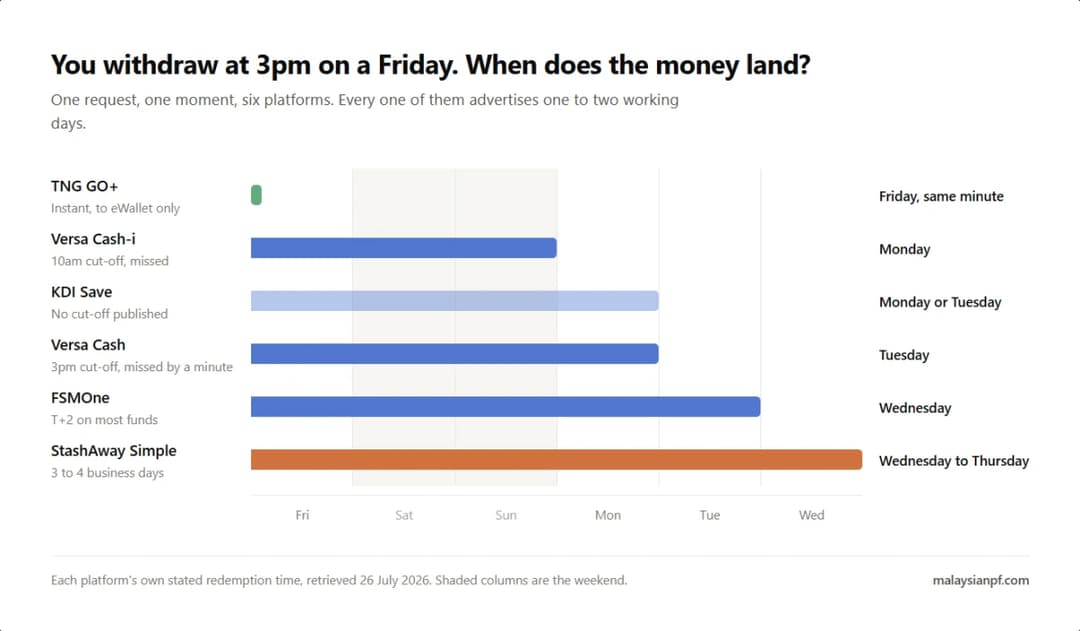
Two things fall out of that table.
Versa's real-world record is worse than its stated one. Seven independent reports between 2023 and 2026 describe two to five days against an advertised one business day. Users also report Cash-i clearing faster than conventional Cash, which matches the official cut-off times.
The Islamic option is the fast one. Versa Cash-i settles same day where conventional Versa Cash takes an extra day. That is the only place I found where choosing the Shariah product changes the speed rather than just the compliance.
And there is a question none of them answer: does your money still earn on the days it is in transit? Not one platform states it plainly. If RM50,000 sits in limbo for four days earning nothing, that is roughly RM18 of yield quietly gone, and it makes a headline rate difference of 0.1% look irrelevant by comparison.
The PIDM Question
Money market funds are unit trusts. PIDM's own page lists unit trusts under products that are not protected. There is no deposit insurance here at all.
What protects you instead is structural, and it is not nothing: the fund's assets are held by a trustee, separate from the manager. Real trustees on these funds include HSBC (Malaysia) Trustee and Deutsche Trustees Malaysia. If the manager fails, the assets are not theirs to lose.
The rules are tighter than most people assume, too. A money market fund must keep 90% of NAV in short-term instruments, cannot put more than 20% with a single issuer (30% for the top-rated), and nothing it buys can have more than 397 days to maturity. Worth knowing the redemption backstop: the guidelines give a manager up to seven business days to pay you, and permit suspending dealing for up to 21 days in exceptional circumstances. Nobody is doing that. But "T+1" is a service promise, not a legal entitlement.
There is also a wording trap worth knowing. The SC's guidelines prohibit calling a fund "capital protected" unless it qualifies, and reserve "guaranteed" for funds with an actual licensed bank guarantor. "Capital preserved" is not a regulatory term at all. I searched the guidelines and it does not appear. It sits in the gap between a banned word and a reserved one, which is exactly why marketing likes it.
The neat way to hold this in your head: the fund's money really is sitting in bank deposits, and those deposits are insured. But PIDM follows the depositor, and the depositor is the fund, not you.
Two details on the deposit side that are worth knowing, because most people get them wrong. The RM250,000 limit covers principal and interest, and it aggregates across all your personal accounts at one bank rather than applying per account. But Islamic and conventional deposits get separate limits, in PIDM's own words: "Islamic and conventional deposits are eligible for a separate deposit insurance limit of RM250,000." So RM500,000 at a single bank is protectable if you split it across both.
Also check that your "bank" is one. Membership is licence-based, and Bank Rakyat and Agrobank are not PIDM members. Bank Rakyat is a cooperative, and its own product disclosure sheet says so. BSN is a third case: not PIDM-covered, but its disclosure sheet claims a Government of Malaysia guarantee. And an e-wallet is not a bank at all.
Where the Digital Banks Beat the Funds
This is the part that changed since I first wrote this post.
| On RM10,000 | Effective rate | Catch |
|---|---|---|
| Ryt Save Pockets | 4.00% | 5 stamps every 30 days, ends 30 Sep 2026 |
| GXBank Bonus Pocket, 6 months | 3.55% | Hold the full tenure |
| Boost BoostUP + Hello2026 | 3.51% | RM500 a month of eWallet spend |
| AEON Savings Pot | 3.00% | Ends 31 Aug 2026, then 0.25% |
| GXBank main account | 2.00% | None at all |
All PIDM protected to RM250,000. Several beat every money market fund on this page. I looked at one of these banks in detail in my Ryt Bank review.
But now put RM100,000 in and the table turns over:
| On RM100,000 | Effective rate | Headline was |
|---|---|---|
| Boost BoostUP + Hello2026 | 3.32% | 4% |
| KAF | 3.04% | 5% |
| GXBank Bonus Pocket | 2.78% | 3.55% |
| Ryt | 2.44% | 4% |
| GXBank main account | 2.00% | 2% |
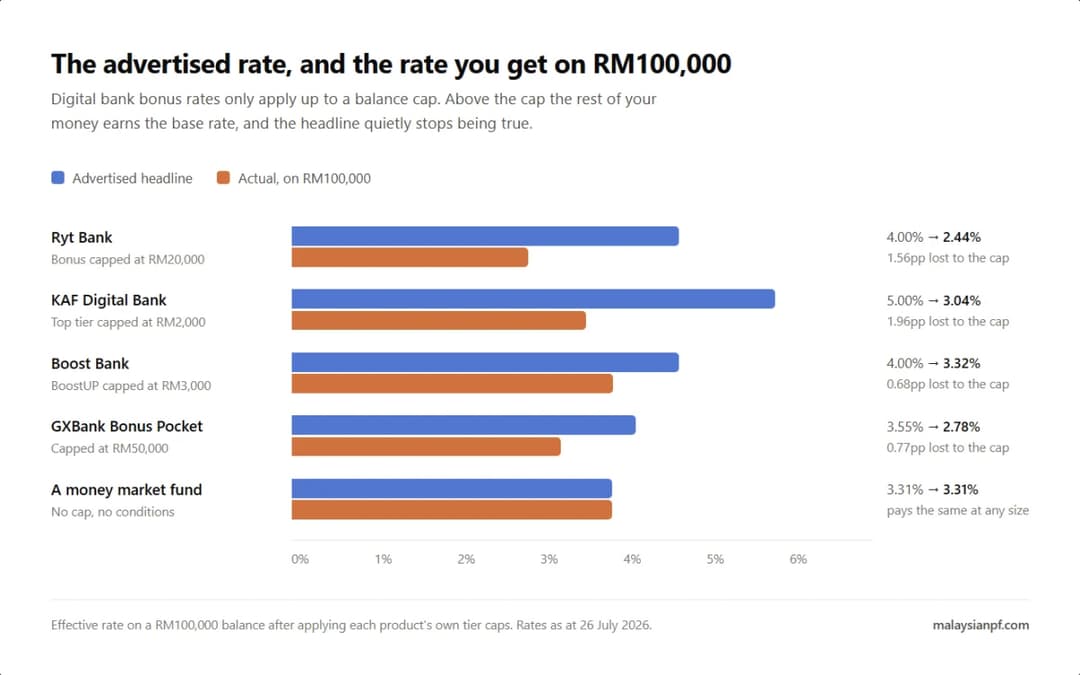
Ryt goes from first to eighth, because its bonus only applies to the first RM20,000. Base 2.05% on everything, plus 1.95% on that first slice, gives 2.44% blended on RM100,000. KAF's 5% tier caps at RM2,000, so it is worth at most RM100 a year. Boost's 4% caps at RM3,000 while demanding RM6,000 a year of spending to keep it.
Money market funds pay their rate on any amount. That is the whole argument for them.
So the honest split:
- Under about RM20,000: a digital bank pocket pays more and is PIDM protected. Use it.
- Above that: the funds win on the uncapped rate, and you are trading deposit insurance for roughly 1% more yield.
- Money you cannot commit for a fixed tenure: the funds win, because most of the good bank rates require a lock or a monthly spend.
One warning on that first table. Four of the five best rates expire within about two months, and the AEON one is worth spelling out: the Savings Pot pays 3.00% until 31 August 2026, then reverts to a contractual 0.25%. That is a twelve-fold drop on a date already in their terms. Boost and Ryt both end 30 September 2026.
Digital bank promo rates are exactly as temporary as the ones I criticised above. The difference is that these ones have published end dates, so at least you can diarise them.
What About Just Using a Fixed Deposit
Board rates at the big five are worse than these funds and identical to each other, to the basis point: 1.75% at 1 and 3 months, 1.85% to 1.90% at 6 to 12 months. UOB is the outlier at 2.05% to 2.20%. All of them sit below the 2.75% policy rate.
Promotional FDs are a different story, and right now the best short-term rate in this entire article is one:
| Campaign | Rate | Tenure | Minimum | Ends |
|---|---|---|---|---|
| MBSB Term Deposit-i | 3.73% | 6 months | RM1,000 | 31 Jul 2026 |
| Maybank eIFD-i | 3.65% | 12 months | RM1,000 | 31 Aug 2026 |
| CIMB eFD-i | 3.60% | 7 months | RM1,000 | 3 Aug 2026 |
MBSB at 3.73% beats every money market fund here and it is PIDM protected. If you can lock money for six months, that is simply the better trade.
Two things worth knowing before you go hunting.
Islamic campaigns are frequently the only campaigns. Board rates are identical between Islamic and conventional at every major bank, because both anchor to the same OPR. But at CIMB and Maybank right now, the only deposit promo running is the Islamic one. These products are open to everyone regardless of religion.
And breaking an FD early now costs you everything. The old "half the interest after three months" rule is history. HSBC pays zero on anything placed since 1 March 2025. Alliance has paid nothing since 2019. OCBC states plainly that no interest is paid on premature or partial withdrawal. That is the real argument for a money market fund: not the rate, the fact that leaving does not cost you the return.
Fees, and the Number You Cannot See
Malaysian funds must publish returns net of fees. The SC guidelines require fees to be accrued daily against NAV, and performance to be calculated NAV to NAV. So when you compare two published fund returns, the fees are already in them. That is the one thing you do not need to adjust for.
What you should look at is the gap between the advertised fee cap and the fee actually charged:
| Fund | Marketed as | Actually charged | Deed allows up to |
|---|---|---|---|
| Maybank Retail Money Market-I | up to 0.50% | 0.25% | not stated |
| Eastspring Islamic Income R | not stated | 0.25% | 2.50% |
| AHAM Enhanced Deposit | up to 0.50% | 0.30% | 3.00% |
| Principal e-Cash | not stated | 0.45% | 3.00% |
Two things there. The real fee is usually about half the marketed cap, which is good news you have to dig into an annual report to find. And the deed allows far more than either. A fund charging 0.25% today has room to go to 2.50% without a new prospectus. Nobody is doing that, and I am not predicting it. But it is worth knowing the ceiling is not where the marketing implies.
Does a higher fee buy you anything? No. BIMB Shariah IncomePlus charges 0.15% and returned 3.41%. United Money Market Class C charges up to 0.75% and returned 3.29%. Across the Moomoo lineup, three funds with fees from 0.25% to 0.75% returned within five basis points of each other.
The Whole Category, Ranked
Everything above is about platforms. Here is the actual fund universe, screened across every MYR money market fund and cross-checked against two independent databases that agreed to within 0.03 percentage points.
| Fund | Manager | Type | 1Y | Minimum | Retail? |
|---|---|---|---|---|---|
| Astute Dana Al-Kanz B | Astute | Islamic | 3.77% | RM100 | Yes |
| KAF Money Market | KAF | Conventional | 3.67% | RM1,000 | Yes |
| BIMB Shariah IncomePlus | BIMB | Islamic | 3.41% | RM10,000 | Yes |
| AHAM Enhanced Deposit | AHAM | Conventional | 3.40% | RM1,000 | Yes |
| Nomura i-Cash | Nomura | Islamic | 3.34% | RM10,000 | Yes |
| Public e-Cash Deposit | Public Mutual | Conventional | 3.34% | RM10 | Yes |
| Maybank Retail Money Market-I | Maybank | Islamic | 3.31% | RM1,000 | Yes |
| Hong Leong Money Market | Hong Leong | Conventional | 3.26% | RM1,000 | Yes |
| Maybank Corporate Money Market I B | Maybank | Islamic | 3.32% | RM10,000,000 | No |
| AHAM Select Cash | AHAM | Conventional | 3.31% | RM1,000,000 | No |
Data as at 22-23 July 2026.
Notice what the apps are not showing you. KAF Money Market pays 3.67% at a RM1,000 minimum and appears on no consumer platform in this article. Public e-Cash Deposit pays 3.34% at a RM10 minimum. Both beat KDI Save's unconditional rate comfortably.
But look closely at the fund on top, because it makes the point of this whole article better than anything else here. Astute Dana Al-Kanz pays the highest yield on the board at the lowest fee, 0.20%, from a RM100 minimum. It is also the least cash-like fund in the top group. Its holdings are commercial paper concentrated in construction and property names: Gabungan AQRS at 18.17%, OCK at 13.53%, Gamuda at 9.27%, Sunsuria at 9.11%. And the fund itself holds only RM4.86 million.
That extra 0.4% of yield is not free. It is paid for with credit concentration in a small fund. Compare Hong Leong Money Market Fund, which is 100% deposits and cash, holds RM3.66 billion, takes RM1,000, and returns 3.26%. You give up about half a percent to hold something genuinely boring.
Neither is wrong. But if you skim a league table and buy the top row assuming all money market funds are the same thing, you have taken on a credit position you did not know you were taking.
Also notice two funds near the top that you cannot buy. Maybank Corporate needs RM10 million. AHAM Select Cash needs RM1 million. A fund you cannot reach is not an option, and screeners rarely tell you which is which.
Now the part that should calm you down. Forty-two percent of retail funds sit between 3.20% and 3.40%. Among the 51 retail classes paying 3.00% or more, the entire spread from best to worst is 0.76 percentage points. So the difference between diligent fund-picking and just picking a reasonable one is small. Avoiding a genuinely bad fund matters. Optimising between two decent ones mostly does not.
One caveat on that table, because it matters for TNG GO+ users. Constant-NAV share classes are systematically understated in these databases. Principal e-Cash Class A shows 2.02% while Class B of the same fund with the same fee shows 3.35%, and Principal's own page shows around 3.07% to 3.15%. The screener is reading a unit price that never moves by design. Trust the fund manager's own fact sheet over any aggregator for these.
For context on scale, money market funds held RM76.6 billion as at 31 December 2025, about 13% of all Malaysian unit trust assets, and they took the largest net inflow of any category that year at RM7.1 billion while equity funds lost RM10.1 billion. A lot of people are parking cash.
Buying the Fund Directly
You do not need any of these apps. FSMOne lists 20-plus money market funds with a 0% sales charge on all of them, which makes the old worry about front-loaded unit trust fees obsolete for this category.
A few that stand out:
| Fund | 1Y return | TER | Minimum |
|---|---|---|---|
| Maybank Retail Money Market-I | 3.31% | 0.27% | RM1,000 |
| Nomura i-Cash Class C | 3.35% | 0.25% | RM10,000 |
| RHB Money Market | 3.26% | 0.58% | RM100 |
| Public e-Cash Deposit (via Public Mutual) | 3.45% | not published | RM10 |
Public e-Cash Deposit is the quiet one. 3.45% as at 31 March 2026, a RM10 minimum, no sales charge, T+1 redemption through their online platform. It beats KDI Save's unconditional rate by more than half a percent and asks nothing of you.
One thing to read before you park idle cash in the platform's own account rather than in a fund. FSMOne's marketing says your money is "kept separate and securely held with Maybank Custodian. We don't touch it." Their terms, clause 3.14, say something more specific: idle cash is "co-mingled with excess monies from other customers of iFAST in an omnibus trust account", and the customer "agrees to waive and relinquish in favour of iFAST any and all entitlements to interest" on it.
Both statements are theirs and both are true. But it means the rate they pay on idle cash is a rate they choose to pay, not your entitlement to the interest underneath. Segregation protects you if FSMOne itself fails. It is not deposit insurance, and there is no compensation scheme mentioned anywhere in their terms. Money inside an actual fund is a different matter, held by that fund's trustee.
Two things to watch when buying direct. Share classes matter enormously: Principal e-Cash Class A returned 3.39% while Class B returned 3.57%, same fund, same fee, because one distributes daily and one accumulates. And retail investors can generally only reach Class A. Second, some funds carry a high own-minimum that the platform hides. Eastspring Islamic Income Class R asks RM50,000 if you go direct, and Moomoo only gets you in below that by pooling you as a nominee, which means you are not a unit holder under the fund's deed.
Tax
Distributions from a Malaysian retail money market fund are not taxable in your hands, and you do not declare them.
The providers all cite Paragraph 35, Schedule 6 for this, and that is the wrong provision. Para 35 covers government securities, SC-approved debentures and sukuk, and Bon Simpanan Malaysia. It says nothing about bank deposits.
The mechanism that actually applies is two steps. The fund's own income is exempt at fund level, mostly under Para 35A, which exempts a unit trust's interest from Malaysian licensed banks. Then Section 61(1A) carries that exemption through to you:
"Provided that the unit holder shall not be assessed and charged to tax in respect of any amount distributed by the unit trust out of income exempt from tax..."
Right answer, wrong citation, everywhere. Worth noting the exemption is conditional rather than a law of nature: wholesale money market funds lost it. Every fund discussed here is retail, so this does not affect you.
If you see a platform claiming money market distributions face withholding tax, that is not correct for a Malaysian resident individual holding a retail fund.
What About the Rate Environment
The OPR has been 2.75% since July 2025, held again at the 9 July 2026 meeting. Inflation was 1.9% in June 2026. So the real policy rate is about +0.85%.
The more useful number is that 3-month KLIBOR sits around 3.45%, roughly 70 basis points above the OPR, up from about 50 in January. These funds are earning a wide spread over the policy rate because short-term liquidity is tight, not because the OPR is generous.
That matters for what could go wrong. No economist I found is forecasting a cut, and several banks expect a hike in 2027. But the spread can compress with the OPR completely unchanged, and if it does, today's 3.4% drifts down without any headline event to warn you. Fund yields also lag: with roughly a third of the portfolio maturing every month, these funds take a couple of months to catch up in either direction.
So What Should You Do
Money you can lock for six months. An Islamic term deposit at 3.73%, PIDM protected, beats every fund on this page. Take it. Just diarise the maturity date, because breaking it early now forfeits everything.
Parking under RM20,000 that you want to keep reachable. A PIDM-protected digital bank pocket pays more than any fund here. Take the protection.
Parking a larger sum, or money you might need without notice. A money market fund pays its rate on the whole balance. Maybank Retail Money Market-I via FSMOne, or Public e-Cash Deposit at a RM10 minimum, are both cheaper and better-disclosed than the app-wrapped versions.
You want the money instantly. TNG GO+ is genuinely instant, but only back into your eWallet. Note that moving cash from your eWallet balance into GO+ moves it out of PIDM protection, because the plain eWallet balance is held in bank trust accounts and GO+ is a unit trust. Quick Cash In does that automatically, without asking.
You are already on a broker. Moomoo Cash Plus is fine and its fees are genuinely zero at the platform layer. Ignore the 7-day yield display and check the fund's own fact sheet. More on the platform itself in my Moomoo Malaysia review.
You want Shariah-compliant. Versa Cash-i settles same-day, which is faster than the conventional option. Maybank Retail Money Market-I and Eastspring Islamic Income are both solid and cheap. On the fund side Islamic options pay very slightly less, about 11 basis points on a like-for-like comparison of funds from the same manager, which is roughly RM11 a year on RM10,000. On the deposit side the opposite is true and Islamic campaigns are currently the better deal.
You are leaving KDI Save and want to know where to go. This is the most-asked question in Malaysian personal finance forums right now, and it currently has no good answer anywhere. Judging by where people say they went: Ryt, ASM, GX or AEON, FSMOne, UOB One and Versa. Based on the numbers in this article, the honest ranking is an Islamic term deposit if you can lock for six months, a digital bank pocket under RM20,000, and Maybank Retail Money Market-I or Public e-Cash Deposit for anything larger or anything you need reachable.
Worth adding one thing about qualifying for KDI's top tier: several users report losing money or breaking even in KDI Invest, which is the product you are now required to hold to get 3.88%. A guaranteed 1% of extra interest funded by a market-risk position is not a free 1%.
One last thought on KDI Save, because it used to be the easy answer. It is the only product here that will not tell you what it invests in. Every other fund on this page publishes a fact sheet with its holdings, its credit quality, its fees and a dated return. KDI's terms refer to "underlying money market fund investments" and never name them. Kenanga discloses the underlying fund for their US Dollar product, so this is a choice, not an industry norm. At 4% with no conditions, that was easy to overlook. At 2.88% it is harder.
What Do You Think?
Rates in this category move every few months, and half the good ones expire before the year is out.
- Where are you parking your short-term cash right now, and has the KDI change moved you?
- Has anyone actually timed a withdrawal end to end, especially over a weekend?
- Anyone using a digital bank pocket instead of a fund, and does the tenure lock bother you?
Drop a comment and let me know what you are seeing.