
Quick Verdict
I used KDI Save on and off for years, and it used to be the easiest recommendation in Malaysian personal finance: 4% a year, no conditions, no quests, withdraw whenever you want.
That version of KDI Save is gone.
Since 16 June 2026, the headline rate is 3.88% p.a., and you only get it if you keep at least RM5,000 sitting in KDI Invest, which is a market-risk portfolio, not cash. Park your money in KDI Save alone and you now earn the Base Tier of 2.88% p.a.
So the verdict depends entirely on how much cash you are parking. If you hold RM20,000 or more in KDI Save and you were going to invest anyway, qualifying for Tier 1 still pays and it is still one of the better rates around. If you are parking RM5,000 for three months before your next bill, KDI Save has quietly become a mediocre product, and at 2.88% with no deposit insurance it is now worth asking why you would not just use a PIDM-protected digital bank instead. The arithmetic is below.
What Actually Changed in June 2026
Here is the old structure, which ran from 14 June 2023 all the way to June 2026. I checked an archived copy of Kenanga's own page to be sure I was not remembering it generously.
| Tier | KDI Save balance | KDI Invest required | Rate |
|---|---|---|---|
| Tier 1 | RM0 to RM50,000 | None | 4.0% |
| Tier 2 | RM50,000.01 to RM200,000 | None | 3.5% |
| Base Tier | Above RM200,000 | None | 3.0% |
Note the third column. Nothing. For three years the 4% was unconditional, which is exactly why so many of us used it.
For the longer view, KDI Save launched in February 2022 at 3.0%, went to 3.5% in October 2022, then to 4.0% in June 2023. So the rate climbed for the first 16 months and then sat still for three years. June 2026 is the first cut in the product's life.
Here is what replaced it, from KDI Save's own rate page, effective 16 June 2026:
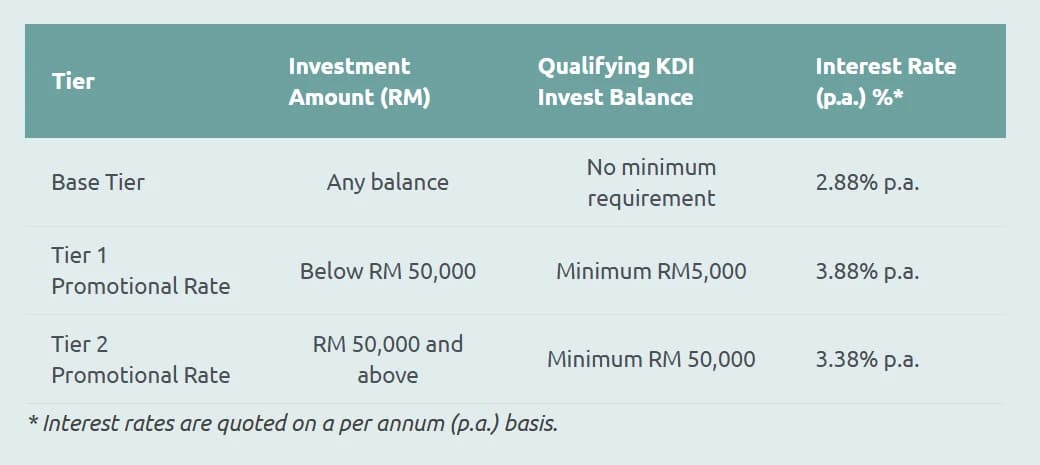
That is Kenanga's own table. The third column is the whole story: 3.88% below RM50,000 needs RM5,000 in KDI Invest, 3.38% above RM50,000 needs RM50,000 in there, and if you hold neither you get the Base Tier of 2.88%.
Read the headlines only and this looks like a 12 basis point trim, 4.0% down to 3.88%. I would not have complained about that, because the OPR is where it is and every cash product in the country has drifted down.
But that comparison only holds if you qualify. If you use KDI Save the way most people did, as a standalone place to park cash, you did not go from 4.0% to 3.88%. You went from 4.0% to 2.88%. That is a 112 basis point cut, and it is the number the marketing does not put in a headline.
One more wrinkle in comparing the two tables: the old rates were quoted as an Effective Annual Rate, the new ones as a simple p.a. figure. So the two headline numbers are not strictly like for like either.
One thing worth flagging: Kenanga's marketing table and its own terms and conditions disagree about which tier RM50,000 exactly falls into. The marketing table says Tier 1 covers RM0 to RM50,000, while the T&Cs say Tier 1 is "Below RM 50,000" and Tier 2 is "RM 50,000 and above". If you are sitting on exactly RM50,000, assume the T&Cs win.
Why the Rate Was Always Going to Fall
I said in my money market fund comparison that the 4% promo rate was unsustainable, because Kenanga was topping up the actual money market return out of a customer acquisition budget. I am not claiming any great insight here. It was just obvious arithmetic.
Bank Negara's Overnight Policy Rate is 2.75%, cut from 3.00% on 9 July 2025 and held there ever since. KDI Save invests in "high quality Ringgit-based money market and/or fixed income financial instruments." Those instruments earn something close to the OPR.
So paying you 4% while the underlying assets yield somewhere near 2.75% to 3% means somebody is subsidising the difference. That works while you are buying customers. It does not work forever.
What surprised me was not the cut. It was the method: instead of just dropping to an honest 2.88%, they kept a 3.88% headline and attached a condition that pushes you into a fee-paying product.
The Real Cost of Reaching 3.88%
This is the part the marketing does not do for you.
To qualify for Tier 1, you must hold RM5,000 in KDI Invest. KDI Invest charges a 0.70% annual management fee, plus 8% SST since 1 October 2025. That works out to 0.756% a year.
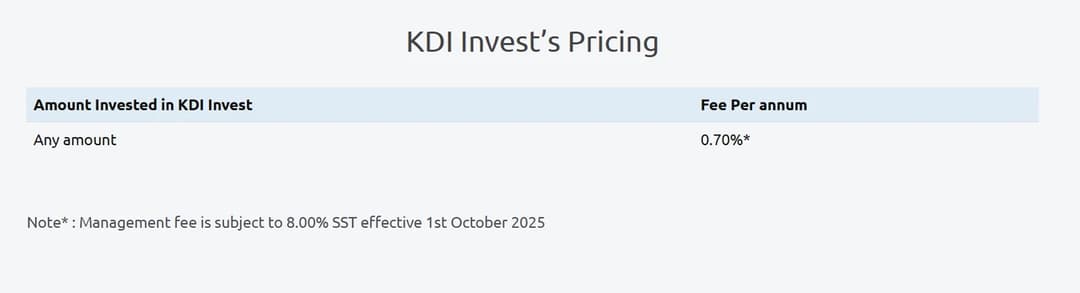
KDI Save itself is free. The product you have to buy to unlock its best rate is not. (Source: Kenanga Digital Investing)
Annual fee on the RM5,000 you are forced to hold:
RM5,000 x 0.756% = RM37.80 per year
And the bonus you are buying is the gap between Tier 1 and Base, which is 3.88% minus 2.88%, or exactly 1.00% on your KDI Save balance.
| KDI Save balance | Extra interest at 1.00% | KDI Invest fee | Net gain |
|---|---|---|---|
| RM5,000 | RM50.00 | RM37.80 | RM12.20 |
| RM10,000 | RM100.00 | RM37.80 | RM62.20 |
| RM20,000 | RM200.00 | RM37.80 | RM162.20 |
| RM30,000 | RM300.00 | RM37.80 | RM262.20 |
| RM50,000 | RM500.00 | RM37.80 | RM462.20 |
The break-even is here:
RM37.80 / 1.00% = RM3,780
Below roughly RM3,780 in KDI Save, the management fee on the qualifying balance eats the entire bonus and you are working for free.
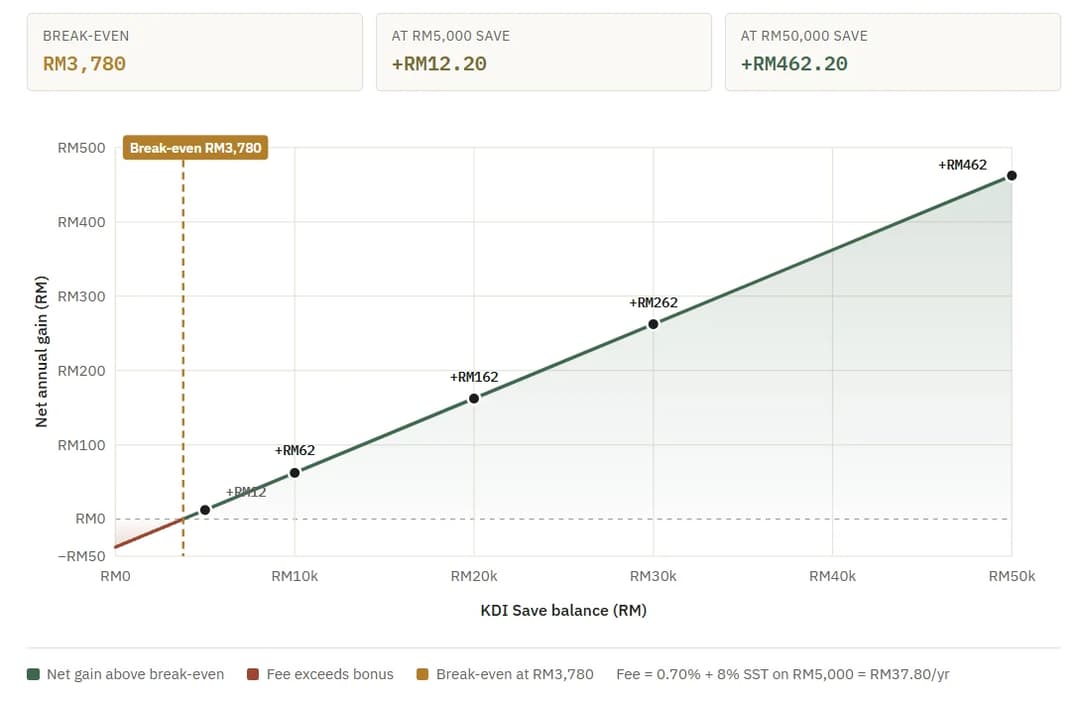
The red stretch on the left is the part nobody advertises.
But the fee is the smaller problem. The bigger one is that the RM5,000 in KDI Invest is not cash. It is invested in ETFs and it can fall. Ask how big a drop wipes out a year of your bonus:
- Parking RM10,000 in Save: your bonus is RM100. A 2% dip in the RM5,000 erases it.
- Parking RM20,000 in Save: your bonus is RM200. A 4% dip erases it.
- Parking RM50,000 in Save: your bonus is RM500. It takes a 10% dip to erase it.
A 2% move in an ETF portfolio is a normal Tuesday. A 10% move is a bad year but not a rare one.
So the structure quietly punishes exactly the people it looks most attractive to. If you are parking a small emergency fund, chasing 3.88% means putting a chunk of it at market risk for maybe RM12 to RM60 a year. That is a bad trade and you should just take the 2.88%, or go elsewhere.
If you already invest and RM5,000 in ETFs is money you were committing regardless, then the qualifying balance costs you nothing you were not already spending, and Tier 1 is close to free money.
Is KDI Save Safe?
This is the most common question I get about KDI Save, and the answer has not changed.
KDI Save is not PIDM protected. Kenanga states it plainly: "No, KDI Save is not PIDM insured." Their own terms add that "Deposits placed under KDI Save are not protected under Perbadanan Insurans Deposit Malaysia."

Straight from Kenanga's own FAQ.
That is not a scandal, it is just what the product is. KDI Save is an investment solution, not a bank deposit, so deposit insurance does not apply to it, the same as Versa, StashAway Simple, GO+, or any money market fund. If PIDM coverage is non-negotiable for you, you want a fixed deposit or a savings account at a licensed bank, full stop.
What you do get: KDI Save sits under Kenanga Investment Bank Berhad, licensed by the Securities Commission of Malaysia under eCMSL/A0008/2007, and Kenanga is an established name on Bursa, not a startup that appeared last year. The disclosed risks are the ordinary ones for money market instruments, namely "credit/default risks and interest rate risks."
Realistically, the chance of losing principal in a Ringgit money market portfolio is low. Low is not zero, and it is not the same as guaranteed. Kenanga also reserves the right to "revise, vary or discontinue the Promotional Interest Rates," which is precisely what they just did.
Two bits of context that I think are fair to include, since I went looking for them.
Kenanga Digital Investing does not appear on the Securities Commission's Investor Alert List, and I found no enforcement action against KDI or KDI Save. That is the answer to the "is this a scam" version of the question. It is not.
Separately, the SC did take administrative action in July 2025 against two sibling asset-management companies in the group, Kenanga Islamic Investors Berhad and Kenanga Investors Berhad, with penalties of RM675,000 and RM300,000 for breaches including "failure to conduct its business with due care, skill and diligence and act in the client's best interest." Those are different legal entities running different products, and none of it involves KDI Save. I mention it because "Kenanga is an established name" is a reason for comfort that should come with the full picture rather than half of it.
The App Is the Weak Point
If I have one warning that has nothing to do with rates, it is this one.
| Store | Rating | Ratings count |
|---|---|---|
| Google Play | 2.2 / 5 | 246 |
| Apple App Store | 2.3 / 5 | 107 |
Those are unusually poor scores for a licensed financial platform, and they are not a small sample. I checked both stores directly rather than take anyone's word for it.
The KDI app on Google Play as at July 2026.
The complaints cluster in two places. The first is account opening, where reviewers report repeated failures at IC verification and OTP codes arriving after the entry window has already expired. The second is funding, where a bank redirect bug on deposits shows up in reviews across roughly a year.
This is other people's experience rather than mine, so weigh it accordingly. But if you are opening a new account specifically to chase 3.88%, budget for some friction, and do not leave the transfer until the day you need the money to start earning.
The other thing worth knowing about the app: some users have questioned whether their realised interest matches the advertised rate. I could not verify those calculations, and there are legitimate explanations available, including tiering and the withdrawal ordering rules. Still, it is worth checking your own statement rather than assuming the headline applies to your whole balance.
The Practical Details
These are the things I actually care about day to day, all from Kenanga's own pages.
| Item | KDI Save |
|---|---|
| Minimum initial deposit | RM100 |
| Minimum top-up | RM10 |
| Management fee | 0.00% |
| Expense ratio | 0.00% |
| Withdrawal fee | None |
| Minimum withdrawal | RM10 |
| Lock-in | None |
| Withdrawal time | 1 to 2 working days |
| Interest crediting | Daily, compounded daily |
| PIDM protected | No |
Two details worth knowing. Deposits take 1 to 2 working days to show up, counted from an 11am cut-off on working days, so money moved on a Friday afternoon is not earning over the weekend. And withdrawals are applied against your lower-rate balances first, which is sensible but worth remembering if you are straddling tiers.
Interest accrues daily including weekends, and compounds daily. Kenanga is careful to note that the quoted p.a. figure "does not include the compounding effect," so the number you see is the annualised daily return, not an inflated projection. Credit where it is due, that is more honest than most of the industry.
How It Compares Now
The honest answer is that KDI Save's edge has mostly evaporated, and the interesting competition is no longer other money market platforms.
| Where | Rate | Conditions | PIDM |
|---|---|---|---|
| KDI Save, Tier 1 | 3.88% p.a. | RM5,000 in KDI Invest | No |
| KDI Save, Base | 2.88% p.a. | None | No |
| Versa Cash | 3.48% p.a. | June 2026 net return, not a promise | No |
| StashAway Simple | 3.4% p.a. projected | 3.55% only with a 6-month new-joiner boost | No |
| GX Bank | 2.00% p.a. | None | Yes, to RM250k |
| CIMB 12-month FD | 1.90% p.a. | Locked to maturity | Yes, to RM250k |
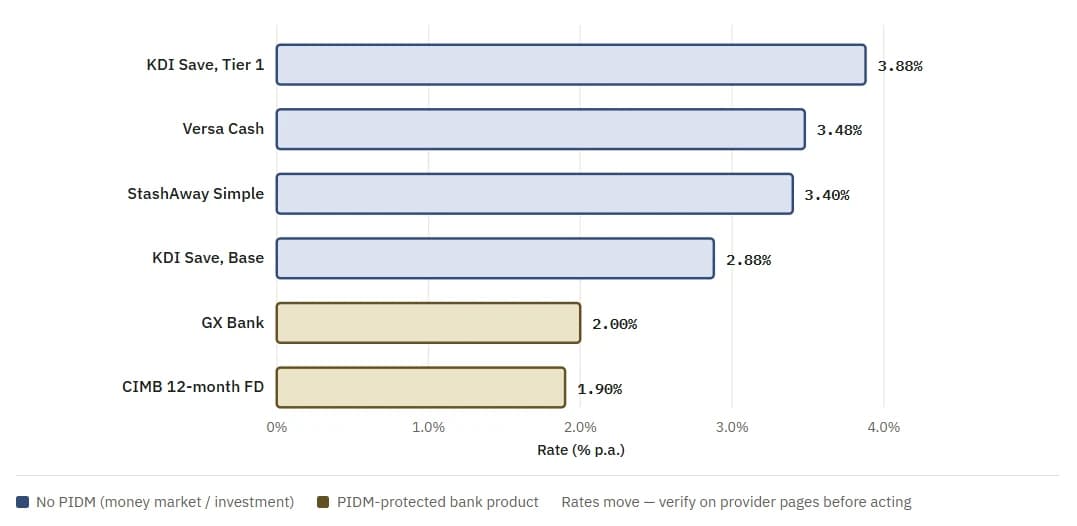
Only the bottom two carry PIDM protection.
A few things fall out of that table.
Versa's plain net return on Versa Cash was 3.48% for June 2026, which is comfortably above KDI's base tier and requires no investment product. My old complaint about Versa still stands, in that the eye-catching numbers are quest-based and time-limited, and their headline promotional rates are invitation-only with caps. But the boring base rate is now better than what KDI pays an unconditional saver.
StashAway needs a correction to what you may read elsewhere, including from me if I had not checked. The 3.55% on their marketing is a projected rate, and their own footnote says the projected rate "is not guaranteed and is 3.4% p.a. as of 19 August 2025." The extra 0.15% is a boost for new investors that lasts six months. So the durable number is 3.4%, projected, not fixed.
The comparison I find most damning for KDI's base tier is the last two rows. A licensed digital bank paying 2.00% with PIDM protection to RM250,000 is only 88 basis points behind KDI Save's unconditional rate, and it carries no credit risk to you at all. For a genuine emergency fund, I would rather have PIDM coverage and 2.00% than no coverage and 2.88%. That was not a trade worth thinking about when KDI paid 4%. At 2.88% it is.
Fixed deposits remain the floor. CIMB pays 1.90% on a 12-month FD as of 19 June 2026, and Maybank is in the same region. Money market platforms still beat FDs, so the category has not stopped making sense. It is KDI's specific advantage inside the category that has gone.
One caution on all of the above: these rates move constantly and several are promotional. Check the current number on the provider's own page before you shift money, because the whole lesson of this post is that a rate you verified last year is not a rate you have today.
So What Am I Doing With Mine?
Nothing, and I should be upfront that this predates the June change.
I do not currently have any cash in KDI Save. That is not a reaction to the rate cut. It comes from how I think about money at this stage of life: if you are young, the bigger risk is being too conservative, not too aggressive. Money market funds are for short-term cash and emergency funds, and that is the only job I ever gave KDI Save. Every other ringgit belongs in something that actually compounds.
So when I did use it, it was for a few months of bills or a buffer, never as a place to accumulate. If your situation is the same, note where that puts you on the table above: a buffer-sized balance is exactly the size where qualifying for Tier 1 makes the least sense, because the fee on the RM5,000 eats most of the benefit and you have taken on market risk to earn it.
There is a second reason the qualifying condition does not appeal to me, and regular readers will already know it. To reach 3.88% you have to hold a robo-managed portfolio, and I have been fairly blunt that I think robo-advisers encourage people to stop thinking about their own financial planning. Being nudged into one to unlock a cash rate is not a trade I want, whatever the arithmetic says.
If you do need a parking spot and the amount is buffer-sized, I would take PIDM protection over the extra yield. At that size the difference is a few ringgit a month, and the protection is worth more.
Plenty of people reached the same conclusion in June for different reasons. The reaction in the Malaysian personal finance forums was mostly unhappy, with a lot of readers treating the KDI Invest requirement as a nudge they did not ask for and moving their cash elsewhere.
The wider point is the one I keep coming back to. A promo rate is a marketing budget, not a product feature. KDI Save paid an unconditional 4% for three years, which was genuinely excellent while it lasted, and I benefited from it. But if your plan depends on a promotional rate holding forever, you do not have a plan. Check what you are actually earning once or twice a year, because the platform will not send you a warning when the number drops.
No referral link here, and no affiliation with Kenanga. I have no money in the product as I write this, so I have nothing riding on which way you decide.
What about you, did the June change push you out of KDI Save, or are you topping up KDI Invest to keep the 3.88%? I am genuinely curious whether anyone has run the numbers and decided the qualifying balance is worth it, especially if you are parking less than I would have guessed.