
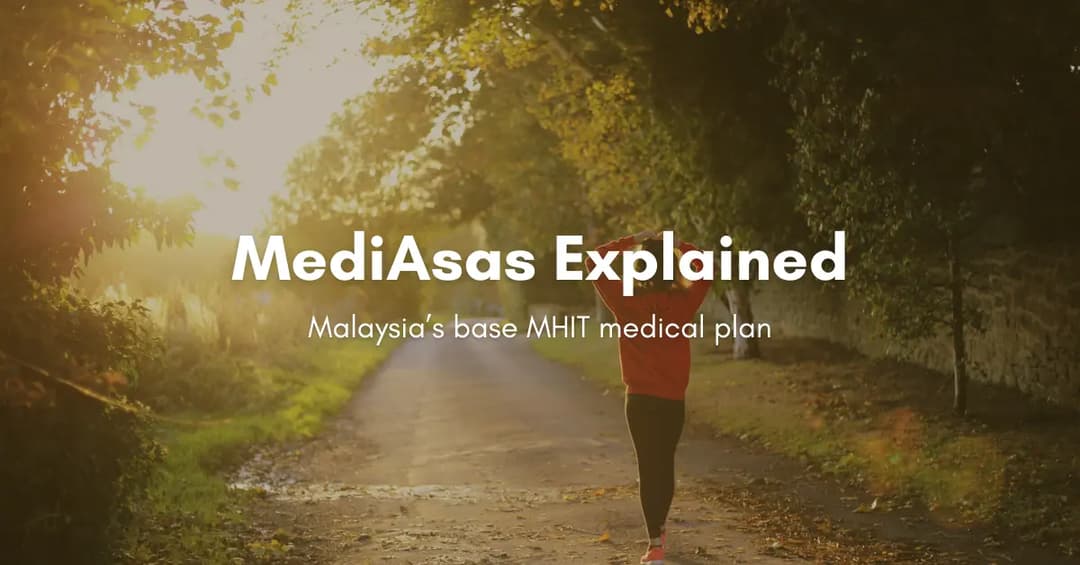
The government's base medical insurance plan finally has a name. It's called MediAsas, the official brand for what was long known as the base MHIT plan, and a pilot programme starts at the end of July 2026 in the Klang Valley.
MHIT stands for Medical and Health Insurance/Takaful, the category this plan sits in. Here are the key facts first:
-
Premiums are expected to range from RM60 to RM550 a month, with joining age up to 70 and coverage up to age 85.
-
It comes in two tiers: MediAsas Teras (standard) and MediAsas Fleksi (standard-plus).
-
It is a standalone medical plan. It is not tied to any investment product.
-
Controlled pre-existing conditions, including mental health conditions, will be covered.
-
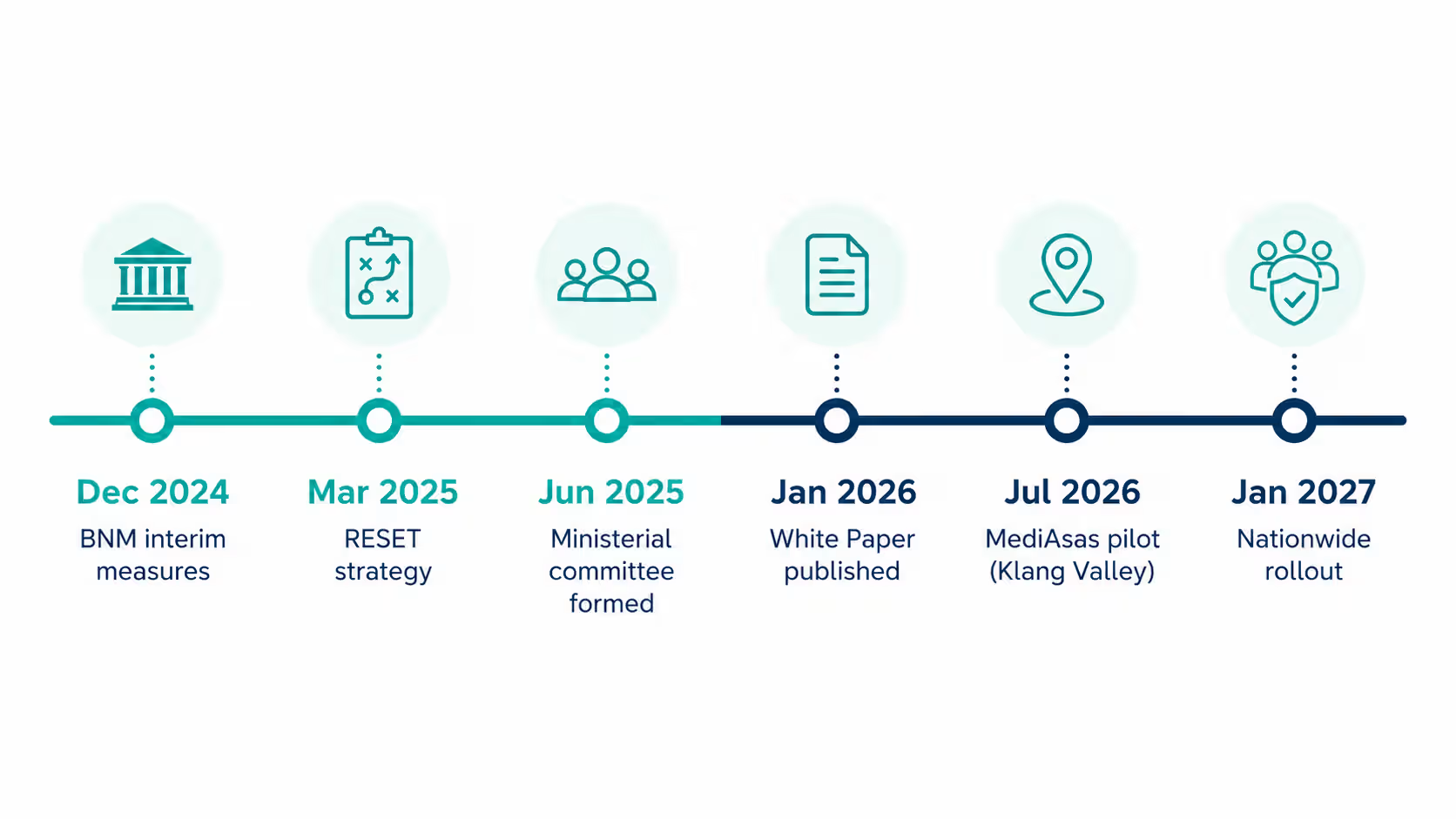
A pilot runs from end July to October 2026 with six insurers and takaful operators. Nationwide rollout is targeted for January 2027 (Finance Ministry announcement).
I've been following this since Bank Negara Malaysia stepped in at the end of 2024, and this is one of the more meaningful changes to Malaysian personal finance in years. Here is what it actually is, why it exists, and who should care.
Why we got here
Medical insurance in Malaysia has a cost problem.
Bank Negara said medical cost inflation hit 15% in 2024, more than double the global average of around 10%. In late 2024, insurers were planning to reprice premiums by 40% to 70% for some policyholders. The backlash was immediate.
Between January 2024 and June 2025, roughly 340,000 medical insurance policies were surrendered. That is about 5.2% of all MHIT policies. People were dropping coverage they could no longer afford, which defeats the whole point of insurance.
BNM stepped in on 21 December 2024 with interim measures. Insurers had to spread premium increases over at least three years. Policyholders aged 60 and above on minimum plans got a one-year pause on increases driven by medical claims inflation. People who surrendered in 2024 could reinstate without new underwriting. And a RM60 million joint fund was set up to, among other things, develop a base MHIT product.
That base MHIT product is what we now call MediAsas. It sits under a broader healthcare reform agenda called RESET, which covers price transparency, digital health records, and a new hospital payment model called Diagnosis-Related Groups.
What is MediAsas
MediAsas is a voluntary, standardised medical insurance and takaful plan. A few design choices matter here.
First, it is standardised. The benefits are the same no matter which insurer or takaful operator sells it. Premiums are set by the authorities based on actuarial principles and reviewed periodically, not priced freely by each company.
Second, it is standalone. This is a big deal. Today, more than 70% of medical plans in Malaysia are sold as riders to investment-linked policies. Your coverage ends up exposed to how an investment fund performs, and a big chunk of your premium goes to commissions and fund fees. MediAsas cuts all of that out. It is a pure medical plan.
Third, any insurer that offers higher-tier medical plans will be required to offer MediAsas on a standalone basis. So it acts as a common baseline across the market.
To be clear, this is not a government-run social insurance scheme. It is sold by private insurers and takaful operators. You pay the premium yourself, though you can choose to use your EPF Account Sejahtera savings to pay for it.
What it covers
Here is how the two tiers compare, based on the White Paper on the Base MHIT Plan and the July announcements.
| MediAsas Teras | MediAsas Fleksi | |
|---|---|---|
| Annual limit | RM100,000 | RM300,000 |
| Annual limit above age 60 | RM150,000 | RM300,000 |
| Deductible (what you pay first) | RM500 per illness or injury | RM10,000 to RM15,000 per hospital stay |
| Deductible from age 61 | RM1,000 | RM10,000 to RM15,000 |
| Best for | Most hospital bills | Large, rare bills at a lower premium |
The RM100,000 limit on Teras was calibrated to cover the vast majority of common private hospital treatment episodes, based on Bank Negara's claims data. It is not meant for the most extreme cases. Those are expected to remain with the public healthcare system, with MediAsas acting as a complement rather than a replacement.
Covered benefits include hospital room and board, surgical and anaesthetist fees, in-hospital doctor visits, intensive care, ambulance fees, and medications tied to a treatment episode. Pre- and post-hospitalisation care like consultations, diagnostic tests, physiotherapy, and home nursing are covered too. Selected high-cost outpatient medicines for serious illnesses such as cancer, as listed by the Ministry of Health, are also included.
MediAsas also sorts hospitals into two groups, and which one you choose changes how much you pay. This part applies to the standard plan, MediAsas Teras.
-
Hospitals on the plan's list (in-network). These are hospitals that have agreed to the plan's prices and service standards. If you go to one of these, you only pay the deductible, RM500 (or RM1,000 from age 61), and the plan pays the rest.
-
Hospitals not on the list (out-of-network). You can still go to these and still claim, but you pay more: the same deductible plus 20% of the bill, capped at RM3,000 per illness or injury.
The standard-plus plan, MediAsas Fleksi, works differently. Instead of a small deductible, you pay the first RM10,000 to RM15,000 of a hospital stay yourself before the plan kicks in. That large deductible is the main reason its monthly premium is so much lower.
The pre-existing condition win
This is the part I think matters most.
Today, if you have a pre-existing condition, getting medical insurance is hard. Many insurers exclude those conditions or reject you outright. Under MediAsas, controlled pre-existing conditions will be covered, including mental health conditions.
The plan also uses a "no look-back" approach. After a period of continuous coverage, insurers cannot deny a claim solely because of a pre-existing condition. Waiting periods may still apply for specific conditions, but the direction is a clear break from current market practice.
For anyone who has ever been told "sorry, that's excluded" at the worst possible moment, this change alone makes MediAsas worth watching.
What it costs
Premiums are risk-rated by age, gender, and health status, but with safeguards like limits on health-based loadings and broader risk pooling across insurers. Here are the indicative monthly premiums from the White Paper.
| Age band | MediAsas Teras | MediAsas Fleksi |
|---|---|---|
| 31 to 35 | RM80 to RM120 | RM50 to RM70 |
| 61 to 65 | RM280 to RM350 | RM220 to RM280 |
| Above 75 | RM500 to RM780 | RM400 to RM660 |
A few things to note. These are indicative figures, not final. The finance ministry has said the overall range will be roughly RM60 to RM550 a month for entry ages up to 70, and the health minister told Parliament in July 2026 that the basic premium will start at around RM65. Final pricing will only be confirmed closer to the nationwide launch.
The trade-off between the two tiers is the deductible. Fleksi cuts your monthly premium by pushing more of the cost onto you when you actually get hospitalised. A RM10,000 to RM15,000 deductible is a lot of money to find in an emergency, so Fleksi only makes sense if you have that amount sitting in your emergency fund.
The honest concerns
I like this plan, but I want to be fair about the criticisms.
There is no premium subsidy. Unlike Singapore's MediShield Life, MediAsas has no government subsidy for lower-income groups. If you are B40 and struggling, RM65 a month is still money you may not have.
Cheaper plans may already exist. CodeBlue found five existing products offering RM1 million to RM5 million annual limits at similar or even lower premiums than MediAsas Teras. If you are young and healthy, you may find a higher-limit plan on the open market for about the same price.
There is a crowding-out risk. Economist Geoffrey Williams warned that healthier people may downgrade into the cheap base plan, which could shrink the risk pool and push premiums up over time.
And government schemes have a mixed track record. mySalam, the free B40 takaful scheme, paid out only about 54% of critical illness and hospitalisation claims between 2019 and 2024, according to a CodeBlue analysis. Good design on paper does not guarantee good execution.
Who should buy
Now for the practical question. And here I want to be honest about my own bias.
I don't think one medical plan is enough for most people. Insurers don't all pay out the same way, exclusions differ from plan to plan, and a claim that one company denies or caps can sometimes be picked up by another. Having at least two medical plans gives you a fallback when your main plan falls short. That's the lens I'm using here.
With that in mind, two groups stand out.
You already have one plan. MediAsas works well as an affordable second layer. At roughly RM60 to RM120 a month for younger buyers, it's a cheap way to widen your safety net. It can back you up if your main plan's annual limit runs out, and because it's standalone, it's also a clean option to hold onto when you retire and lose your employer cover.
You have a plan, but your pre-existing conditions are excluded. This links back to the pre-existing condition win I mentioned earlier. If your current plan excluded your hypertension, diabetes, or another controlled condition, MediAsas may actually cover it. For people in this group, that's not a bonus. It fills a real and expensive gap.
There's also a third case worth noting. If you've been hit by a premium repricing and are thinking of dropping your plan entirely, you can switch to MediAsas with your current insurer without new medical underwriting. For someone about to lose coverage altogether, that's a far better outcome than going uninsured.
If budget is tight and you have no coverage at all, get one good plan first before thinking about a second. The whole point of medical insurance is to cover tail risk, the kind of bill that wipes out your savings. One solid plan that does that beats two half-measures.
My take
I have said before that insurance is one of the most basic financial tools, and medical cover is the most necessary type. It exists so that one accident or illness does not push a family back into poverty.
The problem is that the market made medical insurance confusing, expensive, and often bundled with investment products most people never needed. MediAsas attacks exactly those problems. It is simple, standardised, standalone, and it covers people the market used to turn away.
It is not perfect, and the concerns above are real. But as a step toward simpler, more honest insurance in Malaysia, I think it is a genuinely good one. I will be watching the pilot closely.
Closing thought
MediAsas is not live nationwide yet. The Klang Valley pilot runs from end July to October 2026, and final pricing is still being worked out before the January 2027 rollout. If you are in the pilot group, your experience will shape how this looks for the rest of the country.
Are you planning to add MediAsas when it rolls out, or are you happy with your current setup? Let me know in the comments.