

What Number Do You Actually Need?
RM2 million? RM4 million? Every few months a survey lands in the news with a bigger figure, and the honest answer is that none of them are your number.
So let me give you the shortest possible version, then show the working.
Pick what you want to spend every month in today's ringgit. Multiply by 12. Divide by your withdrawal rate. Then inflate that answer forward to the year you actually retire. Four steps, and the whole post is about why each one is harder than it looks.
Using three lifestyle tiers, and a 4% withdrawal rate:
| Monthly spending (today's ringgit) | Yearly | Target at 4% |
|---|---|---|
| RM4,000 | RM48,000 | RM1.2 million |
| RM7,000 | RM84,000 | RM2.1 million |
| RM10,000 | RM120,000 | RM3 million |
Those are not my numbers and they are not a recommendation. They are three points on a scale so you can find yours. If you want RM5,500 a month, you are looking at RM1.65 million.
And that RM1.2 million is what you need on the day you retire, not today. That gap is where most retirement plans quietly fail, so we will come back to it.
Where EPF Says the Bar Is
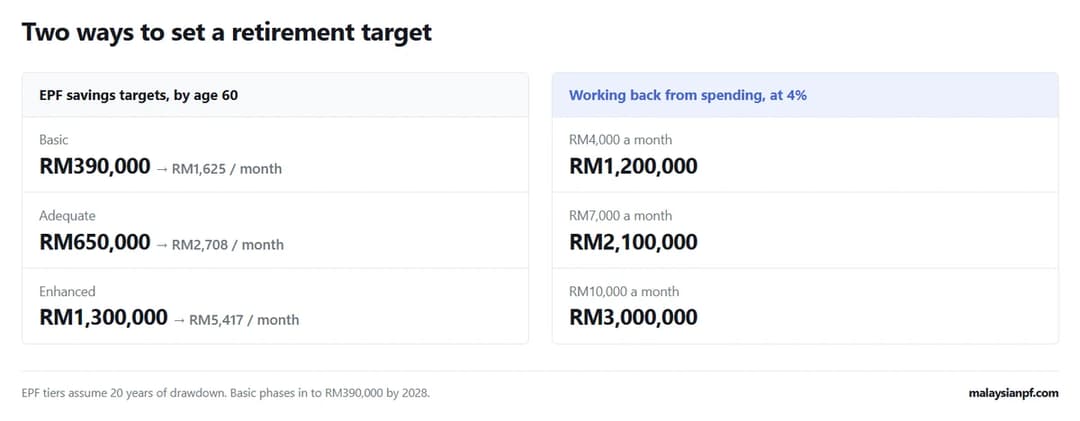
Since December 2024 there has been an official Malaysian answer to this question. EPF's Retirement Income Adequacy framework sets three tiers, each a target to hit by age 60 and expected to last 20 years:
| EPF tier | Target by age 60 | Roughly per month |
|---|---|---|
| Basic | RM390,000 | RM1,625 |
| Adequate | RM650,000 | RM2,708 |
| Enhanced | RM1,300,000 | RM5,417 |
The Adequate tier is not a guess. It comes from Belanjawanku 2024/2025, the Social Wellbeing Research Centre's expenditure guide, which puts a single senior in the Klang Valley at RM2,690 a month and a senior couple at RM3,390. Take RM2,690 over 240 months and you get RM645,600, which EPF rounds up to RM650,000.
Note the RM390,000 Basic target is being phased in: RM290,000 in 2026, RM340,000 in 2027, and the full RM390,000 from 2028.
I wrote about this framework in detail when it launched, including the table-by-age trap that catches people, in Is EPF's Belanjawanku savings target realistic?
My problem with these tiers
Look at what Basic actually buys. RM1,625 a month, for a person who has stopped earning and is over 60. That is not retirement, that is surviving with a roof. Even Adequate at RM2,690 assumes you own your home outright, cook at home, and use government hospitals.
I am not saying the numbers are wrong. Belanjawanku is careful work and RM2,690 genuinely is what that lifestyle costs. My problem is with how the tiers get read. People see "Adequate" and hear "enough," when what it describes is a thin, careful life with no margin for a bad year.
That is why the table at the top of this post starts at RM4,000 rather than RM1,625. If you are reading a personal finance blog on purpose, you are probably aiming past Basic.
The 4% Rule Moved, and Almost Nobody Noticed
The 4% figure everyone quotes comes from William Bengen's 1994 paper. He backtested US market history and found that a retiree drawing 4% of their starting portfolio, raised with inflation each year, survived 30 years even in the worst stretches on record.
Two things about that everybody gets wrong.
First, 4% was never the expected outcome. It was the worst case, the single unluckiest start date in the data. In most historical periods the retiree died with far more money than they started with.
Second, Bengen has since revised it upward twice. His 2020 work put it at 4.5% after adding US small-cap stocks to the portfolio. His 2025 book A Richer Retirement puts the number at 4.7% for a 30-year retirement, and he has been blunt in interviews that 4% is not actually a rule and that he considers even 4.7% conservative for many retirees.
The man who invented the 4% rule does not use 4%. That is worth sitting with.
Here is what the revision does to the same three tiers:
| Monthly spending | At 4% (300x) | At 4.7% (255x) | Difference |
|---|---|---|---|
| RM4,000 | RM1,200,000 | RM1,021,000 | RM179,000 |
| RM7,000 | RM2,100,000 | RM1,787,000 | RM313,000 |
| RM10,000 | RM3,000,000 | RM2,553,000 | RM447,000 |
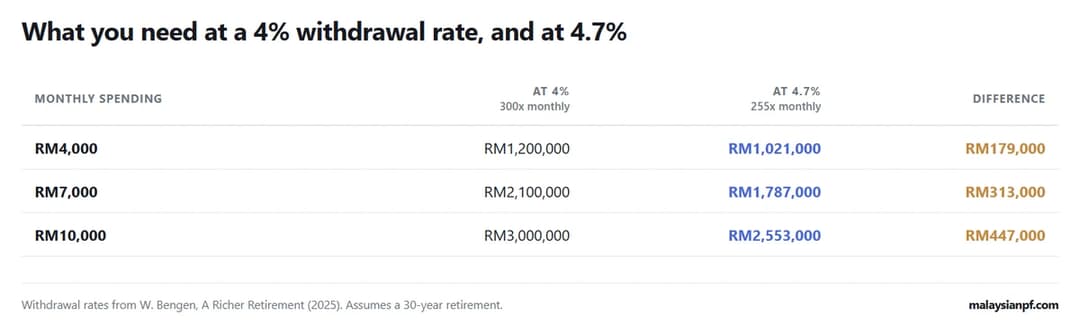
Nearly half a million ringgit of difference at the top tier, from one assumption. That is years of saving.
The shortcut: at 4% your target is your monthly spending times 300. At 4.7% it is times 255.
Before you rush to 4.7%
Bengen's numbers are built on US stock and bond history, with a portfolio that includes US small caps. If your money is not invested like that, his withdrawal rate is not yours.
This is where most Malaysians reading about the 4% rule go wrong. It is not a law of nature. It is the output of one specific market's history and one specific portfolio, and you inherit both when you borrow the number.
If you are investing in US index funds, you can test your own version. FI Calc slices US market history into overlapping retirement periods and reports how many of them your plan survives, and you can change the withdrawal rate, allocation, and duration. Ignore the dollar sign, the arithmetic is identical in ringgit.
What If You Plan to Hold EPF?
Plenty of Malaysians will retire mostly on EPF, so this case deserves its own math.
EPF is not a stock portfolio. I treat it as the bond slice of a portfolio: government-backed, denominated in ringgit, with a statutory floor of 2.5% under the EPF Act 1991. The last decade of declared dividends for Simpanan Konvensional:
| Year | Dividend |
|---|---|
| 2025 | 6.15% |
| 2024 | 6.30% |
| 2023 | 5.50% |
| 2022 | 5.35% |
| 2021 | 6.10% |
| 2020 | 5.20% |
| 2019 | 5.45% |
| 2018 | 6.15% |
| 2017 | 6.90% |
| 2016 | 5.70% |
That averages 5.88% a year over ten years, which is a genuinely good return for something this safe. The 2025 rate of 6.15% was announced in February 2026.
Now run the drawdown. Take 4% out of a 5.88% return and you have 1.88% left to compound. Against inflation, that is your entire real growth. It works, but the margin is thin, and a couple of weak dividend years early in your retirement eat it.
The comfort here is that EPF has a floor and stocks do not, so it is a fair trade rather than a mistake. Just do not borrow a 4.7% withdrawal rate built on US small caps and then apply it to a fund invested nothing like that.
One thing worth flagging: EPF is entirely in ringgit. If your retirement involves imported goods, overseas medical care, or travel, a weakening ringgit is a cost your EPF statement will never show you.
The Part Everyone Skips: Inflating It Forward
Every number so far is in today's ringgit. If you are 35 and retiring at 60, you do not need RM1.2 million. You need whatever RM1.2 million is worth in 25 years.
That is the single most expensive mistake in retirement planning, and it is invisible because the arithmetic looks fine.
The government's own planning figure is 3%. Use it and here is 25 years:
RM1,200,000 * 1.03 ^ 25 = RM2,512,000
RM2,100,000 * 1.03 ^ 25 = RM4,396,000
RM3,000,000 * 1.03 ^ 25 = RM6,280,000
The RM4,000-a-month tier more than doubles. Not because the lifestyle got better, but because the ringgit got smaller.
Why I use a higher number than 3%
Here is the awkward bit. Official inflation right now is low. DOSM reports 1.4% for full-year 2025, down from 1.8% in 2024, and June 2026 came in at 1.9%. On paper, 3% looks generous.
I still plan on more, and I want to show you why rather than just assert it.
Look inside that 1.4% headline for 2025. The categories a retiree actually spends on are running well above it:
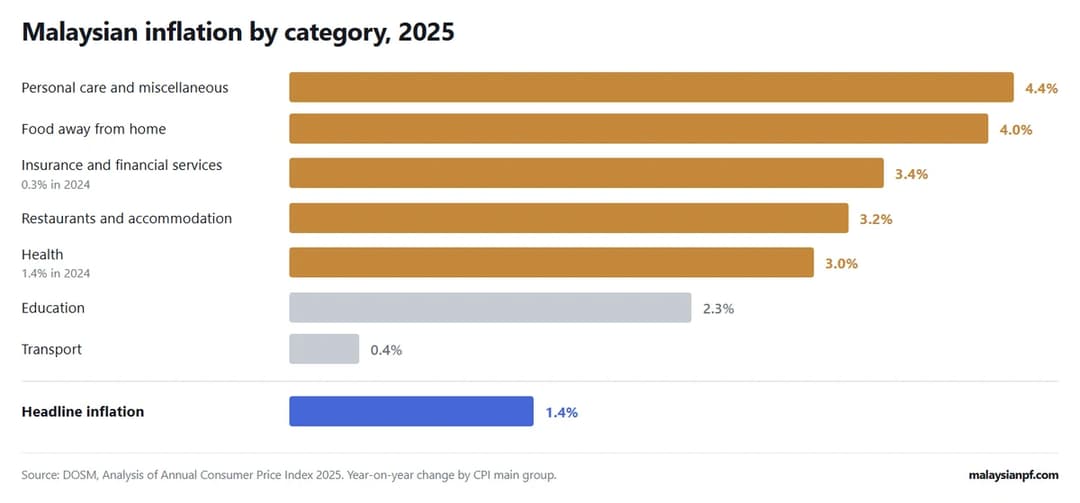
Insurance and financial services went from 0.3% in 2024 to 3.4% in 2025. Health inflation doubled to 3.0%, driven mostly by insurance premiums. Those are exactly the lines that grow as you age, and the headline number is being held down by things a retiree buys less of, like transport and fuel, which sit under heavy subsidy.
The headline CPI is also a national basket. It averages a Klang Valley household against an Alor Setar one, and Belanjawanku's own tables show that gap is real: RM2,690 a month for a senior single in Klang Valley versus RM2,160 in Alor Setar. If you live in a city, buy imported goods, and use private healthcare, your personal inflation is not the national figure.
And subsidies are policy, not physics. Anyone who has watched their electricity bill under the new TNB tariff knows how fast a managed price can stop being managed.
So my approach: use the government's 3% as the baseline, then run a second number higher, and treat the gap as your margin of safety. Being wrong in that direction means retiring with more than you needed. Being wrong the other way means being 72 and short.
At 4% inflation over the same 25 years:
RM1,200,000 * 1.04 ^ 25 = RM3,199,000
RM2,100,000 * 1.04 ^ 25 = RM5,598,000
RM3,000,000 * 1.04 ^ 25 = RM7,997,000
One percentage point of inflation assumption adds RM1.7 million to the top tier. Retirement planning is mostly an argument about assumptions, not about products.
How Long Does the Money Need to Last?
The last input is duration, and this is where people quietly use the wrong statistic.
Life expectancy at birth for a Malaysian is 75.3 years as of 2025. That is the number that gets quoted, and it is the wrong one, because it includes everybody who died young. It is not a forecast for a healthy 60-year-old.
The figure you want is life expectancy at retirement age. DOSM's 2025 tables: a Malaysian reaching 60 is expected to live another 18.8 years if male and 21.6 years if female.
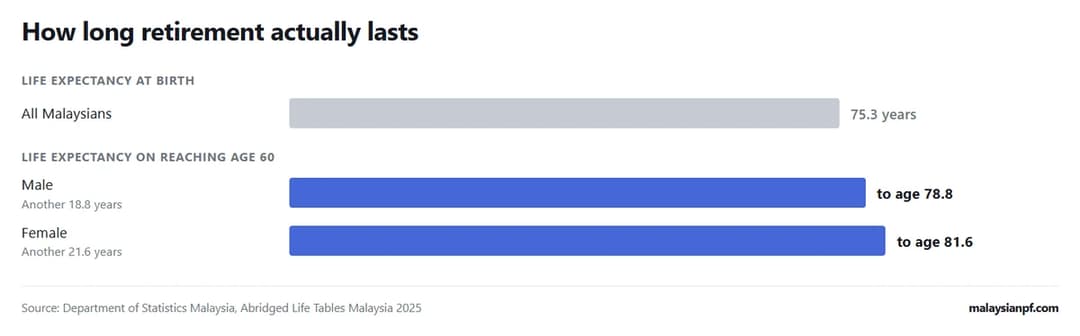
Which explains EPF's 20-year assumption. But planning to the average means roughly half of people outlive the plan, and if you are a woman you should expect to be in that half.
Retire earlier and the problem compounds. At 45, you are funding 35 or 40 years, not 20, and Bengen's own work shows withdrawal rates have to come down as the horizon lengthens. The 4.7% figure is for 30 years. It is not a 45-year number.
Run Your Own Numbers
Rather than sending you off to fill in a bank's form that ends in a call from an agent, use ours:
Retirement Drawdown Calculator
Put in the target you calculated above, your expected return, your monthly withdrawal, and turn on inflation adjustment. It will show you the year your money runs out, which is a more honest output than a single target figure. Try RM1.2 million at 5% return with RM4,000 a month and inflation adjustment on, then try it at 6%. The difference in how long you last is not small.
If you want to work backwards to a monthly savings figure instead, the compound interest calculator does that, and the method is in the Belanjawanku post.
So Is RM1 Million Enough?
This is the most searched version of the question, so let me answer it directly.
At a 4% withdrawal rate, RM1 million funds RM3,333 a month before inflation. Compared to EPF's tiers, that clears Adequate at RM2,690 with room to spare, and falls well short of Enhanced.
If you are retiring today at 60, own your home outright, and are comfortable with the Belanjawanku lifestyle, RM1 million works.
If you are 35 and RM1 million is your target for age 60, it does not. At 3% inflation that RM1 million has the purchasing power of about RM478,000 in today's ringgit by the time you get there, which is a monthly income of RM1,593. You would land under the Basic tier.
Same for RM2 million, which is the other number people search. Today it is RM6,667 a month, comfortably past Enhanced. In 25 years at 3% it is worth RM956,000 in today's terms, or RM3,184 a month, barely past Adequate.
The number is not the problem. The date attached to it is.
The Real Answer
Your retirement number is your monthly spending, times 12, divided by your withdrawal rate, inflated forward to the year you stop working. Everything else in this post is about not fooling yourself on those four inputs.
Where people go wrong, in order of how much it costs them: forgetting to inflate the target, using life expectancy at birth instead of at 60, and borrowing a withdrawal rate built for a portfolio they do not own.
I started running these numbers on myself while I was still in college, and the reason was not discipline. It was that having a target changes what you do with a pay rise. Without one, a raise is just more spending. With one, it is a date moving closer.
Your number will be different from mine and different from EPF's. Just make sure it is a number you calculated rather than one you read in a headline.
What figure are you working toward, and what inflation rate did you assume to get there? I would guess most people reading this have never picked one deliberately.