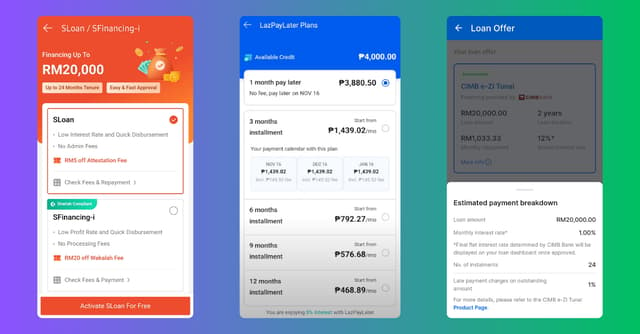

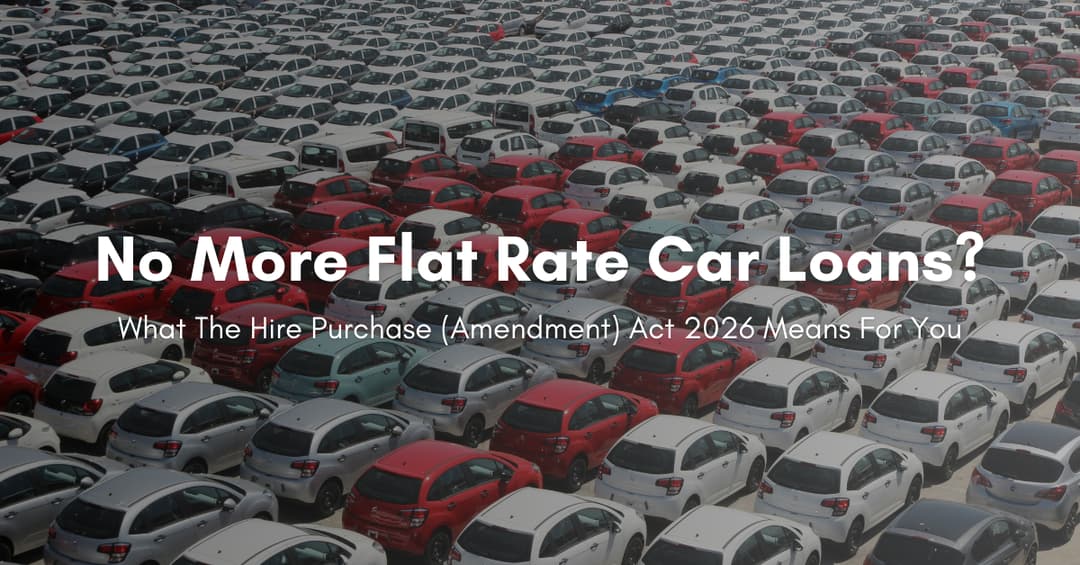
The government passed the Hire Purchase (Amendment) Act 2026 and killed the Rule of 78. It came into force on 1 June 2026.
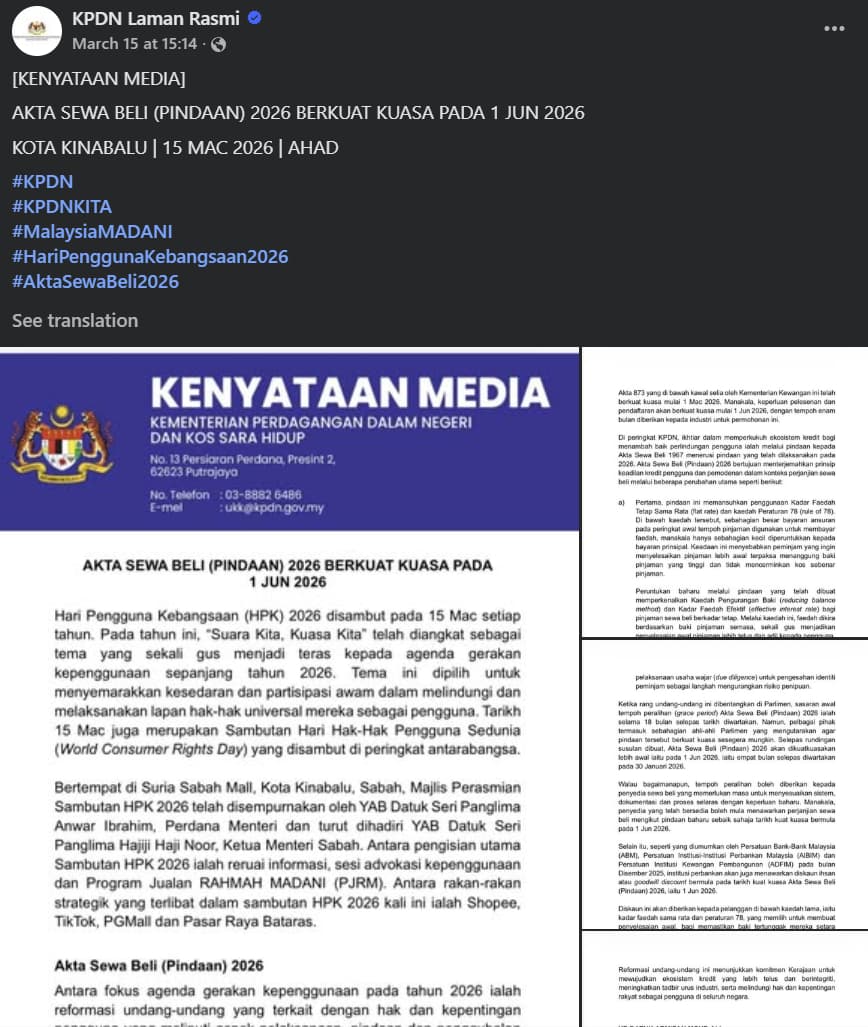
From KPDN Laman Rasmi Facebook
I wrote about this back in March when it was still an announcement. It has been live for almost two months now, so here is what actually happened, including the two parts nobody seems to be talking about.
The short version:
- Your existing car loan does not change. It stays on the old flat rate and the old Rule of 78.
- Never pay extra on it. On a flat rate loan, extra payments save you exactly zero interest. The banks say so in their own documents.
- New loans are not all on the new method yet either. Banks have until 31 March 2027 to switch, and as of today only one has.
- If you settle an old loan early, ask for the goodwill discount. The banks agreed to one in March. Most people have never heard of it.
- Your old loan is probably cheaper than a new one anyway. Refinancing out of it costs more, not less.
Your Existing Loan Does Not Change
I have the same problem myself, so let me answer it properly. My car loan is on a fixed rate, signed under the old rules, and I cannot change the loan type.
The Act is not retroactive. KPDN says it plainly in their own FAQ: the amendments apply only to agreements made after commencement, and existing agreements are not automatically affected. Hong Leong put it even more bluntly in their customer FAQ: "these changes will not impact your current loan account or monthly repayment amount."
So if you signed a 3% flat rate car loan in 2024, you are still on 3% flat. Your monthly instalment is the same number it has always been. Nothing about the new law reaches back and fixes it.
There is one door, and it is only slightly open. KPDN's FAQ says both parties may agree to adopt the new method, subject to the provider being ready. Bank Negara uses the same phrasing: consumers and providers may mutually agree to elect the calculation method.
Read that carefully. It is not a right you can exercise. Your bank has to agree, and a bank that declines is not breaking the law. Hong Leong is not offering conversion. Neither is KFH. I could not find one that is.
You can ask. I would not plan around the answer.
What You Can Actually Do About It
Three real options, in the order I would consider them.
1. Ask for the goodwill discount before you settle early.
In March 2026 the banking associations announced something that got almost no coverage: a goodwill discount for customers settling existing Rule of 78 loans early.
It covers agreements signed before 1 June 2026, or during the transition period. The stated intention is that your outstanding balance ends up "more comparable with what it would have been under the reducing balance method." The catch is that the amount is bank-specific and only disclosed when you request an early settlement quote. You will not see it advertised. You have to ask.
You are not eligible if you are more than 90 days in arrears, under legal action or a repossession order, or already in a restructuring or debt management programme.
2. Refinance into a reducing balance loan. Probably not, and here is the maths.
This was going to be my clever suggestion. The Act has always allowed variable rate agreements, and those never suffered the Rule of 78, because settlement is based on what you actually owe. Eight banks already offer floating rate hire purchase on reducing balance today: Affin Islamic, AmBank, AmBank Islamic, Bank Muamalat, Bank Simpanan Nasional, Hong Leong, MBSB and RHB.
Then I ran the numbers and it fell apart.
Your old 3% flat loan is 5.5% EIR. Reducing balance rates on a used car are worse than that. CIMB publishes 7.40% for a used foreign car and 8.15% for a used national one. Your car is used now, whatever it was when you bought it.
Take our RM100,000 loan at year 3, settle it for RM72,612, and refinance the balance over the remaining six years:
| Total remaining cost | |
|---|---|
| Stay put | RM84,667 |
| Refinance at 7.40% | RM90,140 |
| Refinance at 8.30% | RM92,432 |
Refinancing costs you RM5,473 more in the best case. The break-even is around 5.2% EIR, and almost nothing on the used car market is below that.
So the annoying answer is that your bad old loan is cheaper than the good new loans. Being stuck is not costing you anything.
One warning while we are here. If you search for car refinancing in Malaysia you will find "pajak geran" operators. That is licensed moneylending, not hire purchase, it requires the car to already be fully settled, and I saw one advertising 10% per month. Stay away.
3. Do nothing, which is what I am doing.
I am not touching mine. I will explain why below, because the reason is not laziness.
One thing worth knowing: full early settlement is your statutory right, not a favour. Section 14(3)(a) of the Hire Purchase Act says you may exercise it at any time during the agreement, with written notice. No bank can impose a lock-in period on it.
Flat Rate Is Not Dead Yet
The headlines all said flat rate car loans are dead. They are not, and this is the part I think matters most if you are buying a car this year.
The Act commenced on 1 June 2026, but banks were given a transition period until 31 March 2027 to upgrade their systems. During that window they may keep writing new hire purchase on the old flat rate and Rule of 78 basis. Only eleven providers were operating under the new framework on day one.
The banking associations published a readiness table. Here is when each bank starts offering fixed rate hire purchase on reducing balance:
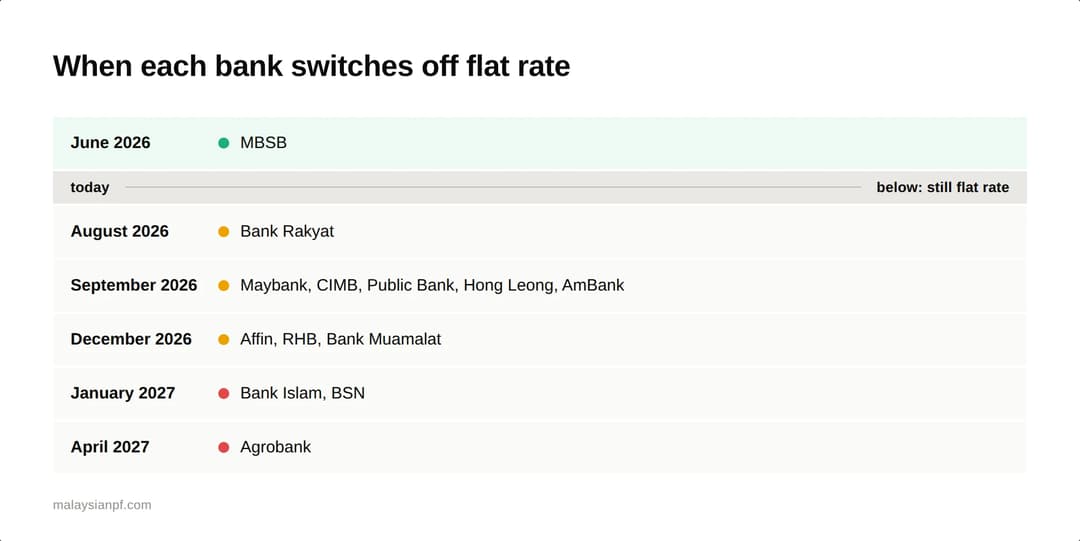
Islamic subsidiaries switch alongside their parent bank. Source: ABM, AIBIM and ADFIM readiness summary, 17 March 2026.
Look at where the line sits. As I write this in late July 2026, MBSB is the only bank that has arrived. Bank Rakyat lands next month, and the big four are not due until September. If you walk into any other bank right now and take a fixed rate car loan, you are almost certainly still getting a flat rate loan with the Rule of 78, and that is entirely legal until March 2027.
Ask the branch which method your loan uses. Do not assume the new law protects you yet, and do not expect the website to tell you either. I went looking for a published car loan rate on the major bank sites and could not find one. Hong Leong's current product disclosure sheet still describes the rate as "fixed interest rate per annum flat" and still prints the Rule of 78 rebate formula. Public Bank's has been updated to reducing balance with a blank field for the effective rate. Neither prints an actual number.
The rates you see quoted on comparison sites, roughly 2.35% to 4.45%, are flat rates from before the change. Do not compare one of those against a reducing balance quote. They are different units.
If you remember one thing from this post, make it this: a 3% flat loan is more expensive than a 5% reducing balance loan. RHB markets its 5.00% reducing balance rate as equivalent to 2.71% flat, and I checked the maths, it is right. So when a salesman offers you 3% flat and the bank across the road offers 5% reducing, the 5% is the better deal. That is how badly the flat number misleads.
While we are correcting things: "flat rate abolished" does not mean "fixed rate abolished." Those are different words. KPDN's FAQ confirms fixed rate loans are still permitted. What changed is how the interest is calculated, not whether your rate can be fixed.
Why the Flat Rate Was Deceptive
Say you take a 9 year car loan and the bank quotes you 3% per annum.
You see 3% and assume it is cheaper than your 4% mortgage. It is not.
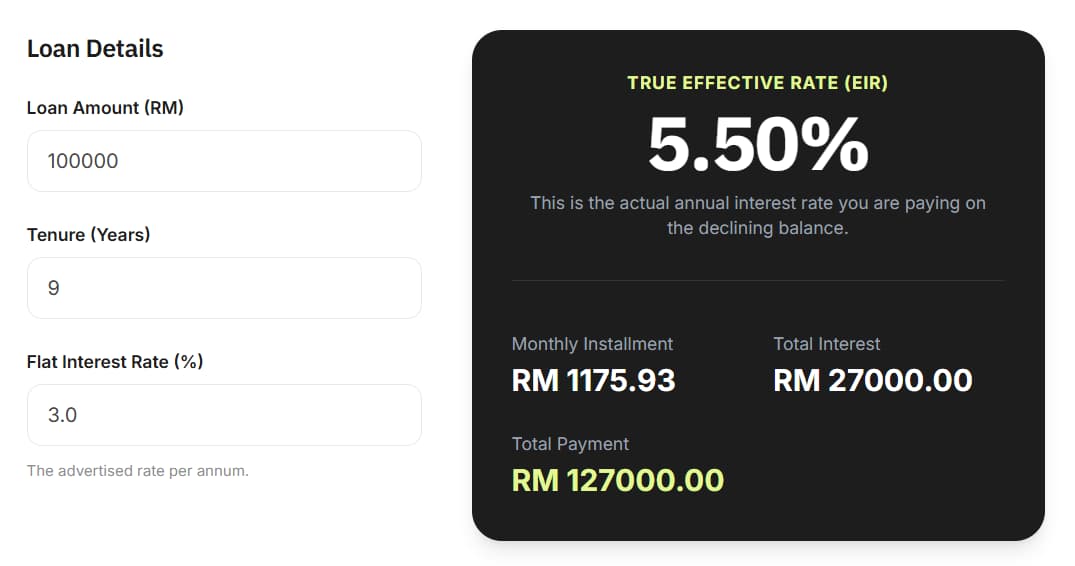
Under a flat rate, interest is calculated upfront on the original amount borrowed. You get no credit for the fact that your balance drops every year.
A 3% flat rate over 9 years works out to an effective interest rate of about 5.5%. Run it yourself if you do not believe me, the maths is just an annuity. So the loan you thought was cheaper than your mortgage is meaningfully more expensive than it.
If you want to see the real rate on your own loan, I built a Flat Rate to Effective Interest Rate Calculator. If you want the mechanics of why flat rates mislead people, I wrote about that here.
The Rule of 78, With Real Numbers
Everyone repeats that the Rule of 78 punishes early settlement. True. But almost nobody says by how much, and when I worked it out, the answer was not what I expected.
The formula is in the Act itself. Your rebate is the total interest multiplied by n(n+1) and divided by N(N+1), where n is the months remaining and N is the total months.
Take RM100,000 financed at 3% flat over 9 years. Total interest is RM27,000, and you pay RM1,175.93 a month.
Settle at the end of year 3:
| Amount | |
|---|---|
| Paid so far (36 instalments) | RM42,333 |
| Rule of 78 rebate | RM12,055 |
| Payoff figure | RM72,612 |
You have completed 33% of the tenure. The bank keeps RM14,945, which is 55% of all the interest on the loan. At year 5 it is worse: you are 56% through, and the bank has kept 80% of the interest.
That is the front-loading people complain about, and it is real.
But here is the part that changed my mind. Compare that payoff to what the same loan would cost on reducing balance at the equivalent 5.5%:
| Settle at | Rule of 78 | Reducing balance | Difference |
|---|---|---|---|
| Year 3 | RM72,612 | RM71,979 | RM633 |
| Year 5 | RM51,050 | RM50,565 | RM485 |
RM633. On a RM100,000 loan.
The Rule of 78 was worth abolishing, and I am glad it is gone. But it was never the thing costing you real money. The expensive part was always that your 3% was actually 5.5%, and you compared it against your mortgage and thought you got a bargain. The rebate formula was a rounding error next to that misunderstanding.
Which is why the transparency matters more than the calculation change.
Does This Make Car Loans Cheaper?
No, and I want to be clear about this because a lot of coverage implied otherwise.
Hong Leong's own FAQ says it out loud: "The total interest cost for full loan tenure for both Rule of 78 and reducing balance method is the same."
Transparency does not lower a price. It just stops you from being misled about it. If banks quote you 5.5% EIR where they used to quote 3% flat, you pay exactly what you always paid. You simply see it now.
The real test is what happens when every bank is on EIR and consumers can compare like with like across nine year tenures. If competition pushes rates down from there, we win. If everyone quotes 5.5% and nothing moves, we got honesty and nothing else.
Honesty is still worth having. I just would not call it a discount.
Never Pay Extra on a Flat Rate Loan
This is the one that could actually cost you money, so I am putting it in its own section.
On a flat rate loan, paying extra each month saves you nothing. Not a little. Nothing.
The interest was calculated upfront on the original amount, so there is no outstanding balance for your extra payment to reduce. Take that RM100,000 loan again and throw an extra RM20,000 at it before settling at year 3. Your payoff figure drops by exactly RM20,000. Not one sen more.
The banks say this themselves, in writing. Affin's product disclosure sheet: any payment above the scheduled instalment "shall not reduce the total interest payable." Hong Leong's auto loan FAQ asks whether principal prepayment on a fixed rate Rule of 78 account earns interest savings, and answers "No."
Meanwhile that RM20,000 sitting in a money market fund at 3.5% for two years becomes about RM21,400. So paying it into the loan does not save you interest, and it costs you roughly RM1,400 in returns you gave up. That is a pure loss.
Under the new reducing balance method the opposite is true. Interest is computed monthly on what you still owe, exactly like a housing loan, so every extra ringgit genuinely reduces principal. RHB's own figures show RM30,000 paid into a reducing balance loan at month 24 saving RM9,821. The same RM30,000 into a flat rate loan saves RM0.
Same money, same car, completely different outcome. Know which loan you have before you pay a cent extra. You can model the reducing balance case with my Amortized Loan Calculator.
If you want to clear a flat rate loan, the only move that works is settling it in full, in one go, which triggers the rebate. Dripping extra money at it does nothing.
Should You Pay It Off At All?
Personally, I am still paying the minimum on my car.
Even at 5.5%, I would rather put the money elsewhere. A diversified index fund has historically returned above that, so throwing spare cash at a 5.5% loan is a poor trade for me. I would rather let it compound.
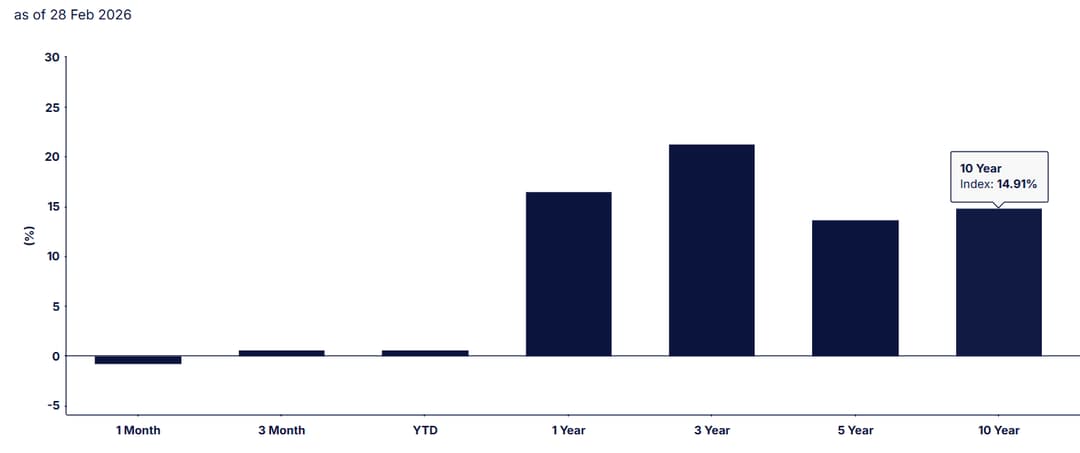
That is a decision about my risk tolerance, not a rule. If debt keeps you up at night, clear it. There is nothing wrong with buying peace of mind, as long as you know the opportunity cost you are paying for it.
The Remaining Problem
Forcing banks to show an effective interest rate on car loans is a solid win. I just hope it does not stop here.
Hiding the true cost of debt is practically an industry standard. Buy Now Pay Later still masks its real rates behind flat fees and confusing terms. Personal loan marketing buries the EIR in the fine print.
The same goes for the fake generosity in bank marketing. "Up to 10% cashback" in big letters, "on the first RM100" in small ones. That is the same trick as the 3% flat rate, just aimed at a different product.
Killing the flat rate car loan fixes a real blind spot. Now do the rest.
So, when your bank finally quotes you 5.5% instead of 3%, does it change your mind about that nine year loan? And if you are on an old loan, are you going to ask for the goodwill discount? Let me know in the comments.